Hong Kong Wine & Dine Festival 2026: Full Guide
Hong Kong Wine & Dine Festival 2026: Full Guide
If you're weighing a Hong Kong trip for late October or trying to figure out what your neighborhood restaurant's "Wine & Dine" set menu is actually tied to, the answer is the same event: the Hong Kong Tourism Board's annual harbourfront food and wine festival, back for its 2026 edition with a bigger wine line-up than usual.
Quick Answer: The Hong Kong Wine & Dine Festival 2026 runs October 29 – November 1 at Central Stage, Central Harbourfront Event Space, with 300+ booths and 100+ restaurants including Michelin-starred kitchens. Entry starts from HK$20; sampling costs extra via a token-based Tasting Pass. The event then rolls into "Hong Kong Wine & Dine Month" through November, with set menus and drink deals at restaurants and bars citywide.
Disclosure: This post contains affiliate links. If you book or buy through them, we may earn a small commission at no extra cost to you.
| Detail | What's confirmed |
|---|---|
| Dates | Thursday, October 29 – Sunday, November 1, 2026 |
| Venue | Central Stage, Central Harbourfront Event Space, Hong Kong Island |
| Organizer | Hong Kong Tourism Board (HKTB) |
| Scale | 300+ booths; 100+ restaurants, including Michelin-starred kitchens |
| Wine focus | New HKTB–Bordeaux Wine Council partnership; pavilions from China, France, Italy, Spain, Georgia, and the UK, plus new Australia, Canada, and South Korea pavilions |
| General admission | Starts from HK$20 (concessions for seniors/students/children); tasting requires a separate token-based Tasting Pass |
| Extension | "Hong Kong Wine & Dine Month" runs through November with set menus/offers at restaurants and bars citywide |
| Closest MTR | Admiralty (~0.6 km), Central and Sheung Wan (~1.1 km) — all Island Line |
When Is the Hong Kong Wine & Dine Festival 2026?
The 2026 festival runs Thursday, October 29 through Sunday, November 1 — a four-day, Thursday-to-Sunday stretch — at Central Stage, Central Harbourfront Event Space. The Hong Kong Tourism Board confirmed these dates in its official festival announcement.
That timing lines it up with the tail end of Hong Kong's most comfortable travel window: humidity has usually dropped by late October, and the harbourfront setting makes evening temperatures genuinely pleasant rather than sticky.
Where Is the Hong Kong Wine & Dine Festival Held?
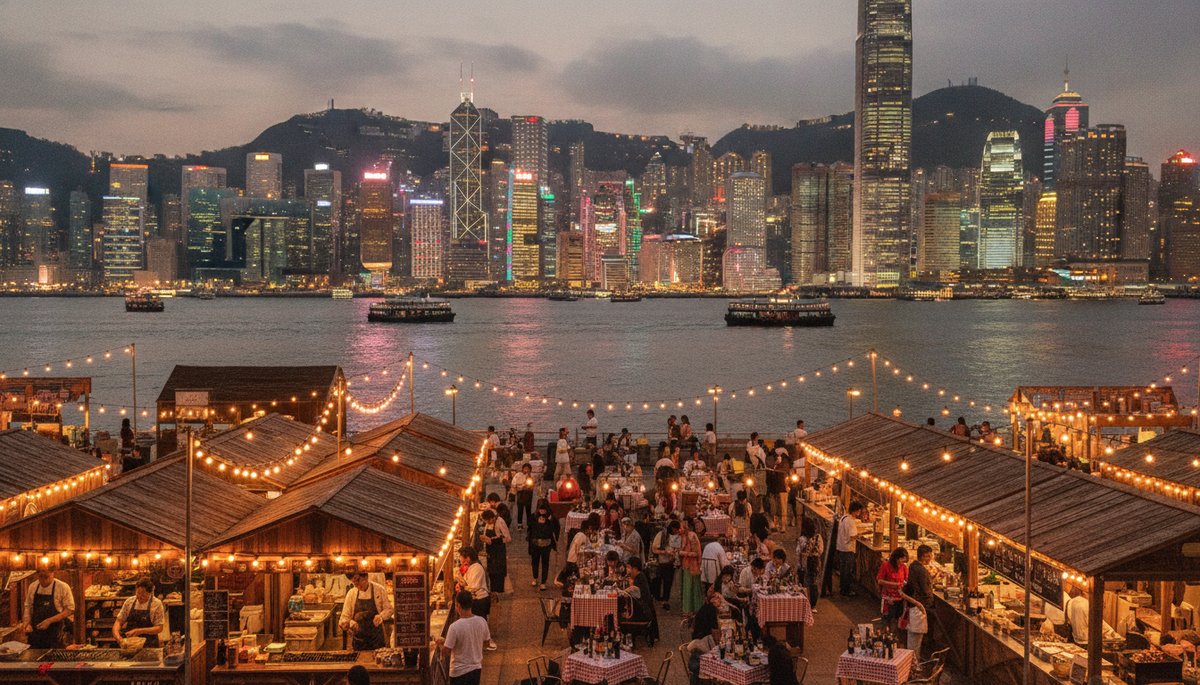
The festival takes over Central Stage at the Central Harbourfront Event Space, the open-air site on Hong Kong Island that sits directly on Victoria Harbour, facing the Kowloon skyline across the water. It's the same site used for several of the city's other big outdoor events.
Getting there by MTR is straightforward. Admiralty station (Island Line, Tsuen Wan Line, South Island Line) is the closest, roughly 600 metres from the venue. Central and Sheung Wan stations are both about 1.1 km away and equally walkable, and Wan Chai station is a slightly longer 1.3 km option if the closer exits are jammed with festival crowds. All are a flat, easy walk along the harbourfront promenade — no hills, which is more than you can say for most of Hong Kong Island.
How Much Does the Hong Kong Wine & Dine Festival Cost?
General admission tickets start from HK$20 (about US$2.50), with reduced pricing for seniors, students, and children, and free entry for kids under three. That covers entry to the grounds, the live stage, and the general atmosphere — it does not include any food or wine.
To actually taste anything, you'll need a separate Tasting Pass, which works on a token system: you buy a pass, it comes loaded with tokens, and you trade tokens for pours and bites at the participating booths. Exact pass tiers and token counts are set closer to the event on HKTB's official ticketing page, so it's worth checking there before you land rather than relying on last year's pricing — festival ticketing structures shift from edition to edition.
Is the Hong Kong Wine & Dine Festival Worth It?
Yes, for most visitors and residents — the low cost of entry and the sheer density of what's on offer make it easy to get your money's worth, even on a tight budget. You're getting access to 300+ booths and 100+ restaurants, including Michelin-starred kitchens, plus live music and masterclasses, all with Victoria Harbour as the backdrop.
The 2026 edition leans harder into wine than past years: the Hong Kong Tourism Board has struck a new partnership with the Bordeaux Wine Council, giving French Bordeaux a dedicated spotlight, alongside pavilions from China, Italy, Spain, Georgia, and the UK, plus new additions from Australia, Canada, and South Korea. Several of Hong Kong's bars from the 2026 Asia's 50 Best Bars list — including Bar Leone, Gokan, and Coa — are also tied into the festival's programming, which is a nice hook if you're already a cocktail-focused traveler.
The trade-off is crowd density: the Saturday and Sunday nights draw the biggest turnout, so if you want breathing room around the booths, aim for the Thursday or Friday opening nights instead.
What Is Hong Kong Wine & Dine Month?
Hong Kong Wine & Dine Month extends the festival's energy through the rest of November, after the Central Harbourfront tents come down. Participating restaurants and bars across the city run exclusive set menus, curated dining experiences, and drink offers tied to the festival theme.
This is effectively how Hong Kong residents get a second bite at the event without needing to fight the harbourfront crowds — book a Wine & Dine Month set menu at a neighborhood restaurant in your own time, on your own schedule, weeks after the main event has wrapped.
The Four Harbourfront Nights, in Practice
With the festival running Thursday through Sunday, you're realistically looking at four distinct nights rather than one big blur:
- Thursday (Oct 29) and Friday (Oct 30): Lighter crowds, easier to move between booths, and a better shot at grabbing a spot near the stage for live entertainment or a masterclass without a long queue.
- Saturday (Oct 31) and Sunday (Nov 1): The busiest nights — bigger crowds, longer lines at popular wine pavilions, and a livelier overall atmosphere if you don't mind sharing elbow room.
If you're only in town for one night, weigh what matters more: elbow room (go Thursday or Friday) or peak energy (go Saturday). If you can swing two visits, opening night plus one weekend night gives you both.
Budget Night Out vs. Full Splurge
The festival's pricing structure makes it genuinely flexible for different budgets.
Budget approach: Pay the low general-admission fee, skip the Tasting Pass, and treat it as a free-to-wander evening — live music, harbour views, and people-watching cost nothing extra once you're through the gate. Pair that with a cheap eat afterward in nearby Sheung Wan or Central. If you're basing your whole trip around a lower daily spend, Hong Kong's hostel scene has grown a lot — check Hostelworld's Hong Kong listings (affiliate link) for options within walking distance of the MTR lines that serve the harbourfront.
Splurge approach: Buy a Tasting Pass, budget extra for the Bordeaux-focused pours and any masterclass add-ons, and treat the whole evening as a proper night out — then follow it up during Wine & Dine Month with a set-menu dinner at one of the Michelin-starred restaurants that participated in the festival's booth line-up.
Either way, the festival's actual admission cost is low enough that the real budget decision is how much you spend on tasting, not on getting in the door.
How Residents Stretch It Into November
If you actually live in Hong Kong, the smart play is to treat the harbourfront festival as the opening act and Wine & Dine Month as the main event. Go to Central Harbourfront once, ideally on a weeknight when it's less packed, then spend the rest of November working through the set-menu offers at restaurants in your own neighborhood — Wan Chai, Sheung Wan, and Tsim Sha Tsui all typically have a strong lineup of participating spots.
This also solves the crowd problem: instead of fighting festival-weekend foot traffic for every dish you want to try, you spread the eating out over four weeks at your own pace, on nights that work for you.
Getting There and Getting Around: MTR, Octopus, and Late-Night Transport
Hong Kong's public transport makes the festival easy to reach without a car, and the same system carries you around the rest of the city if you're stretching the trip into a longer autumn stay for working remotely in Southeast Asia.
Octopus card: Get one at the airport, an MTR customer service counter, or any 7-Eleven before you arrive at the harbourfront — it taps onto the MTR, buses, trams, and ferries, and works at convenience stores too, so it's worth loading before festival night rather than fumbling with single-ride tickets in a crowd. Tourist bundles that combine the Airport Express with a few days of unlimited MTR travel are also available if you're only in town briefly.
Late-night transport back from the harbourfront: The MTR generally runs from around 6am until roughly 1am, though the exact last-train time varies by line and station — check the app before you commit to a late night at the booths. The Star Ferry's Central–Tsim Sha Tsui route typically runs until around 11:30pm if you want the classic cross-harbour view on the way back, and Hong Kong's night bus network keeps running after the MTR closes for anyone staying out later.
Connectivity: If you're arriving from abroad and don't want to hunt for a local SIM on your first night, an Airalo Hong Kong eSIM installs before you land, starting from around US$4, so you've got maps and transit apps working the moment you step off the plane. (Affiliate link — we may earn a commission at no extra cost to you.) If you're routing in via a regional hub, it's worth checking new flight routes into Asia that have opened up recently — connections through the region keep improving. And if you haven't traveled to Asia in a while, run through a digital nomad packing checklist before you go; humid harbour evenings and air-conditioned MTR cars call for different layers within the same day.
Crowds, Pacing, and Autumn Typhoon Awareness
Hong Kong is a well-trodden, low-risk city to navigate, but a harbourfront festival with hundreds of booths still rewards a bit of planning. Pace your Tasting Pass tokens across the evening rather than front-loading pours in the first hour — it's easy to underestimate how far a token-based system stretches once you're a few booths in. Keep an eye on your group in the Saturday/Sunday crowds, and agree on a meeting point near a landmark stage or exit in case you get separated.
Hong Kong's typhoon season officially runs into early November, overlapping with the festival's dates, though tropical cyclone signals are far less common this late in the season than during the July–September peak. It's still worth a quick check of the Hong Kong Observatory's signal status if the forecast looks unsettled in the days before you travel — outdoor festival programming is the first thing adjusted if a signal goes up.
Planning the Rest of Your Autumn Asia Trip
If the Wine & Dine Festival is anchoring a longer autumn swing through the region, it pairs naturally with other early-autumn events — Seoul's fireworks festival runs earlier in the season and gives you a sense of how another major Asian city handles a big outdoor spectacle, if you're weighing where else to build your itinerary around.
Whether you're flying in just for the four harbourfront nights or you're already based in Hong Kong and planning to stretch it into Wine & Dine Month, the structure is the same either way: cheap to walk in, flexible on how much you spend once you're inside, and easy to reach on a system that runs late enough to get you home.
Frequently Asked Questions
When is the Hong Kong Wine & Dine Festival 2026?
Where is the Hong Kong Wine & Dine Festival held?
How much does the Hong Kong Wine & Dine Festival cost?
Is the Hong Kong Wine & Dine Festival worth it?
What is Hong Kong Wine & Dine Month?
You Might Also Like
Travel + Remote Work Briefing — October 18, 2026
Travel + Remote Work Briefing — October 17, 2026

Travel + Remote Work Briefing — October 15, 2026