Barcelona Solar Eclipse 2026: Where to Watch Aug 12
Barcelona Solar Eclipse 2026: Where to Watch on Aug 12
On the evening of August 12, 2026, Spain will witness its first total solar eclipse since 1905. Barcelona won't be in the path of totality — but it will experience an approximately 99.7–99.8% partial eclipse, with the nearly-blotted-out sun hanging low over the Mediterranean just before sunset. For anyone in the city that evening, it will be one of the most dramatic sky events of a lifetime.
Whether you're a visitor, a resident, or a remote worker based in Barcelona, this guide covers exactly where to watch, how to do the totality day-trip to Zaragoza, what eclipse glasses you actually need, and how to plan around what will be Spain's biggest travel day of the summer.
Quick Answer: Barcelona misses totality but sees an approximately 99.7–99.8% partial eclipse — the sun peaks around 20:29 local time (CEST), very low on the west-northwest horizon. Best viewing spots are Barceloneta beach and Montjuic's Mirador del Migdia. For full totality (1 min 25 sec), Zaragoza is 1h 22min by AVE high-speed train from Barcelona Sants. Book tickets now — trains and cars will sell out. ISO 12312-2 eclipse glasses are required throughout the entire event from Barcelona.
Disclosure: This post contains affiliate links. If you make a purchase through these links, we may earn a small commission at no extra cost to you. We only recommend products we genuinely believe in.
Is the August 12 Eclipse Total in Barcelona?
No — Barcelona narrowly misses the path of totality. The city will experience an approximately 99.7–99.8% partial eclipse, which sounds close to total but is fundamentally different in one critical way: that remaining sliver of exposed sunlight is still bright enough to cause immediate eye damage if you look without protection.
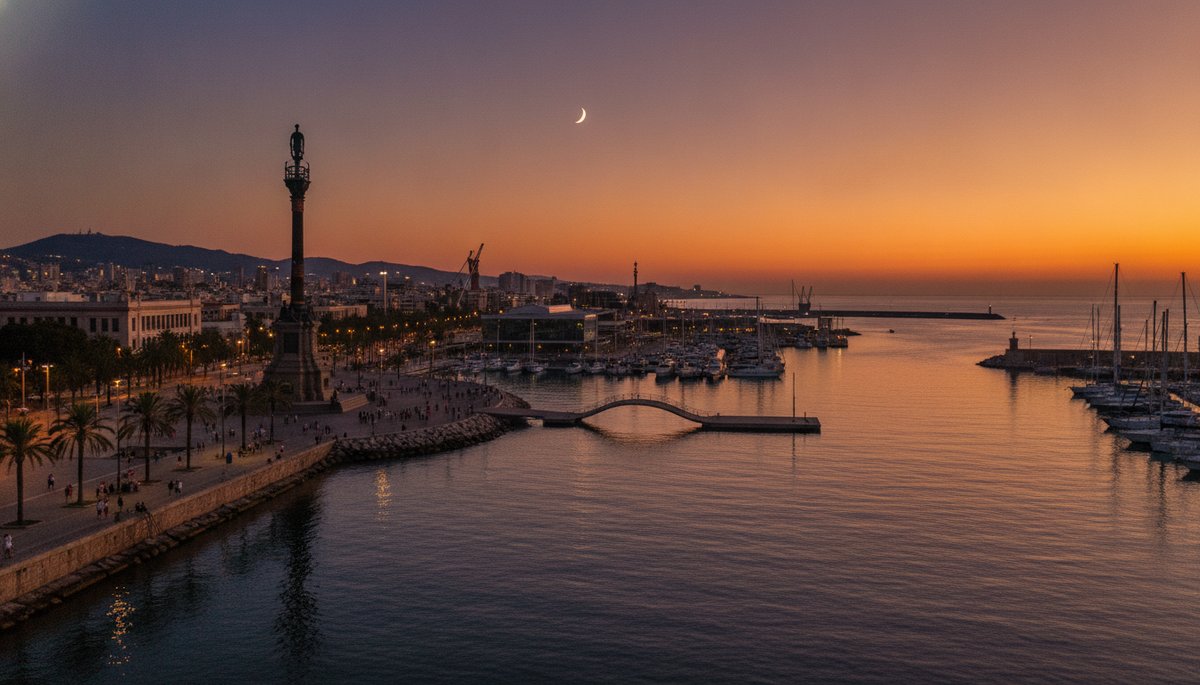
The eclipse begins as a partial in Barcelona at around 19:35 local time (CEST) and reaches its remarkable maximum coverage at around 20:29. From there it continues until roughly 20:55, which coincides with sunset — so the event ends not because the Moon moves on, but because the sun drops below the horizon. You will be watching a near-total eclipse descending toward the sea in the final golden hour of the day. The sky will visibly darken, temperatures will drop a few degrees, and animals in the city may respond to the unusual twilight.
The path of totality in Spain runs from the Atlantic coast in the northwest through Zaragoza and Valencia before crossing the Balearic Islands. Both Madrid and Barcelona sit just outside that band.
Where Can I Watch the 2026 Solar Eclipse in Barcelona?
The key constraint is horizon. At maximum eclipse, the sun will be under 5 degrees above the horizon — barely 4 degrees above the western horizon in the west-northwest direction. Any rooftop bar, viewpoint, or park blocked by buildings or hills in that direction will miss the best moments — or the sun entirely as it approaches sunset.
Barceloneta Beach and the Port
Barceloneta is the single best option for most visitors and residents. The beach faces south-southwest, and the open water horizon stretches in exactly the direction you need. There are no obstacles between you and the setting crescent-sun. The wide sandy strip means thousands of people can gather comfortably, and the natural amphitheatre of the seafront creates a shared atmosphere that a rooftop bar simply cannot replicate.
Arrive by 19:00 to claim a spot. By 19:30 you'll see the first bite out of the solar disc through your eclipse glasses. Bring a blanket — the sea breeze after the eclipse darkens the sky will feel notably cold.
Parc de la Ciutadella (Open Lawns)
The large open meadows in Ciutadella have clear sightlines toward the southwest. The park is close to Barceloneta and the Born neighbourhood, making it easy to combine with dinner afterwards. It's a good choice for families and for remote workers who want a lower-key spot away from beach crowds.
Mirador del Migdia, Montjuic
For the most elevated view of the eclipse over the city, the Mirador del Migdia on the south-facing side of Montjuic faces almost directly toward the critical horizon direction. You'll see the sun descending into its near-total eclipse over the open sea with the Barcelona skyline below you. Take the cable car or Bus Turistic earlier in the day — this viewpoint will be packed, and transport up the hill will be slow on eclipse evening.
What to Skip
Avoid the upper terraces of Bunkers del Carmel or Park Güell — both have stunning views but their best sight-lines face east and northeast, meaning the low western sun may be blocked by the ridge itself. Also skip any covered rooftop bar or restaurant with a partial overhang on the western side.
Practical note: August 12 is already deep in Barcelona's peak summer season. Expect Barceloneta and Montjuic to be exceptionally busy. If you're working remotely that day, clear your afternoon calendar — public transit will be crowded from 18:00 onward, and getting to any viewpoint early is the single most important logistical decision.
How Do I Get to the Path of Totality from Barcelona?
The closest large city inside the totality band is Zaragoza, where the Moon's shadow completely covers the sun for 1 minute and 25 seconds, beginning at approximately 20:29 local time. The drive from Barcelona is around 300 km, but the AVE high-speed train is the more practical option on what will be an extraordinarily congested day.
Barcelona Sants to Zaragoza Delicias by AVE
The fastest AVE services cover the route in about 1 hour 22 minutes. According to Trainline data, roughly 29 train services run daily on this corridor, with OUIGO and iryo offering additional low-cost options alongside the standard Renfe AVE. Advance fares are inexpensive if booked early — check Renfe or Trainline for current pricing and availability.
August 12 is not ordinary circumstances. This will be Spain's single biggest travel day of the summer. Trains running toward Zaragoza in the late afternoon will be among the most in-demand journeys in the country, and seats closer to the August date will carry premium pricing if they're available at all. Anyone planning the day-trip should book as early as possible — ideally months in advance.
A realistic timetable for the day-trip:
Depart Barcelona Sants by 17:00 to allow for delays and to reach Zaragoza with time to find a viewing spot
Totality in Zaragoza: approximately 20:29–20:30
Return trains toward Barcelona: late evening, expect delays and crowds
Allow for the possibility of a late return — overnight in Zaragoza may be the more relaxed option
Other Totality Options
Valencia is further from Barcelona (roughly 350 km south on the AP-7 motorway or direct trains via Madrid) and has 1 minute of totality beginning around 20:32. The totality timing is very similar to Zaragoza's, but Valencia is a longer journey.
Teruel — a smaller inland city in Aragon — sits deeper inside the totality band (1 min 34 sec) and will be far less crowded than Zaragoza. It's accessible by regional train from Zaragoza or by car.
If you're travelling by car, book a rental well in advance and plan to park several kilometres outside any city centre — roads into Zaragoza and Valencia will be gridlocked as totality approaches.
One useful item for the day-trip: if you're crossing from Barcelona into Aragon on a Spanish mobile plan you're covered, but international visitors may hit roaming surprises. The Airalo Spain eSIM covers all of Spain on a single data plan — install it before you leave and you'll have data for navigation, real-time train updates, and sharing the moment, wherever in Spain the eclipse finds you. (Affiliate link — we may earn a commission at no extra cost to you.)
Is the Day-Trip Worth It?
That depends entirely on what you value. The approximately 99.7–99.8% partial eclipse from Barcelona is extraordinarily impressive — visually darker and more dramatic than most people expect from a "partial" event, with the added spectacle of the crescent sun setting over the sea. Many astronomers and eclipse veterans argue that the totality experience — those 1–2 minutes of complete darkness, visible stars, the corona, animals going silent — is categorically different from any partial, however deep.
If you have never seen a total solar eclipse, and you're already in Spain on August 12, the day-trip is worth the effort. The next total solar eclipse over Spain will not happen until August 2, 2027 — but that event favours southern Spain and North Africa (and Spain had to wait 121 years between the 1905 eclipse and this one). If logistics or budget make the day-trip impractical, the Barcelona partial view is still a once-in-a-generation event.
Eclipse Eye Safety: What You Need to Know
This section matters more than any viewing location tip. Solar eclipses — including deep partial eclipses like the one visible from Barcelona — can cause permanent eye damage if you look at the sun without proper protection.
The Only Safe Filters for Direct Viewing
The international standard for eclipse eye protection is ISO 12312-2. Glasses or handheld solar viewers carrying this certification reduce the sun's intensity to a safe level for direct observation. The American Astronomical Society (AAS), which sets guidance followed internationally, specifies that ISO 12312-2 compliance is required for all solar viewing except during the brief seconds of full totality in the total phase — which does not apply to Barcelona, since the city never reaches totality.
Look for the ISO 12312-2 marking on any glasses you buy. Reputable brands include Thousand Oaks Optical, Rainbow Symphony, and American Paper Optics, among others. Buy from established astronomy retailers or directly from the manufacturer — not from informal market stalls where certification cannot be verified.
What Is NOT Safe
Per AAS and NASA eclipse-safety guidance, the following items do not provide adequate protection and should never be used for solar viewing:
Ordinary sunglasses, including very dark ones — even aviation-grade polarised lenses
Smoked glass, CDs, or DVDs
Stacked neutral density camera filters (unless specifically rated for solar viewing)
Phone camera screens — pointing your phone at the sun without a solar filter damages the camera sensor and does not protect your eyes
Auto-darkening welding helmets (shade 13 or 14 welding glass is safe; auto-darkening is not)
The Pinhole Projector Alternative
If certified glasses are unavailable, a pinhole projector lets you watch the eclipse without looking at the sun directly. Pierce a small hole in a piece of card, hold it up to let sunlight through, and project the image onto a second piece of card or a wall behind it. The projected image will show the crescent shape of the partially eclipsed sun throughout the event. This method is completely safe, free, and actually works well for showing children how the eclipse progresses.
The Critical Rule for Barcelona
Because Barcelona never reaches totality, there is no safe moment to remove your eclipse glasses during this event. In the totality zone (Zaragoza, Valencia), observers can safely remove glasses during the 1–2 minutes of full totality — but must put them back on immediately as totality ends. In Barcelona, that moment never arrives.
Planning Around Spain's Biggest Travel Day
The total solar eclipse will fall on a Wednesday in August — already peak travel season in Spain — and will drive travel demand that is likely to rival or exceed any single public holiday in recent memory.
Transport
Trains on the Barcelona–Zaragoza and Barcelona–Valencia corridors should be booked immediately. RENFE, iryo, and OUIGO all sell these routes; check all three for availability since they share track but sell independently.
If you're flying into Barcelona to see the eclipse, check our guide to navigating Europe's summer 2026 flight disruptions — peak August dates already carry elevated disruption risk, and August 12 will be among the busiest days of the year.
For visitors thinking about basing themselves outside Barcelona to be closer to totality, our Mediterranean second cities for summer 2026 guide covers options along the Spanish coast that combine good value with easy access.
Accommodation
Hotels and apartments in Zaragoza and along the totality corridor are booking up quickly. If you're planning a totality trip and haven't already searched, do it today. Barcelona itself will have strong demand even without the totality draw — it's mid-August, and the eclipse will bring additional visitors. If you're already based in the city as a remote worker or long-term visitor, you're in the best position: you don't need to move, and you have a prime coastal viewpoint already.
The Eclipse Within Barcelona's Packed Summer Calendar
August 12 doesn't exist in isolation. Barcelona's summer 2026 calendar is extraordinarily dense — from the Tour de France Grand Départ in early July through Sónar and the city's late-summer festival schedule. For the full picture of what's happening in the city across the season, see our guide to Barcelona's big summer 2026 events.
For remote workers and digital nomads considering whether Spain is a good base for an extended stay, see our EU EES entry system guide for digital nomads — the European Entry/Exit System affects how long non-EU visitors can stay.
Quick Eclipse Day Checklist for Barcelona
Before August 12:
Buy ISO 12312-2 certified eclipse glasses (order online well in advance — Spanish stores will sell out)
If doing the Zaragoza day-trip, book AVE tickets and any overnight accommodation now
Note the maximum eclipse time: approximately 20:29 CEST
Plan your viewpoint — Barceloneta beach or Mirador del Migdia are the top picks
On August 12:
Arrive at your viewpoint by 19:00 — the partial eclipse begins at ~19:35 and crowds build fast
Bring water, a snack, and layers (post-eclipse temperature drop can be sharper than expected)
Keep your eclipse glasses on at all times — there is no safe naked-eye viewing window from Barcelona
Set a phone alarm for 20:25 to make sure you don't miss the peak
Expect public transport delays returning to the city centre after 21:00
Photography: A phone camera pointed at the sun without a solar filter will not produce useful images and risks damaging the sensor. If you want to photograph the eclipse properly, use a dedicated solar filter over your lens. If photography isn't the priority, put the phone away and watch the crescent sun set over the sea — it's worth experiencing with your own eyes.
Spain's first total solar eclipse since 1905 is almost here. Whether you choose the dramatic approximately 99.7–99.8% partial sunset view from Barceloneta or make the train dash to Zaragoza for ninety seconds of totality, August 12, 2026 is a date worth planning around.
Frequently Asked Questions
Is the August 12, 2026 eclipse total in Barcelona?
What time does the solar eclipse peak in Barcelona on August 12, 2026?
Where is the best place to watch the eclipse in Barcelona?
How do I get from Barcelona to the path of totality for the 2026 eclipse?
Do I need special glasses to watch the 2026 solar eclipse in Barcelona?
You Might Also Like
Travel + Remote Work Briefing — October 18, 2026
Travel + Remote Work Briefing — October 17, 2026
Travel + Remote Work Briefing — October 15, 2026