Skip Amalfi: Mediterranean Second Cities 2026
Skip Amalfi: Mediterranean Second Cities 2026
Every summer, Americans fly into Santorini, Positano, and Dubrovnik and spend half their trip fighting Instagram-crowd angles and eye-watering prices. The Mediterranean doesn't have to work that way.
The 2026 booking data is telling a new story. Bodrum, on Turkey's Turquoise Coast, is seeing the fastest demand growth of any Mediterranean destination this year. The Albanian Riviera is drawing comparisons to a pricier Greek coastline — at a fraction of the cost. Sicily is quietly outcompeting the Amalfi Coast on every metric that matters for a real trip. And a handful of Greek and Croatian islands are stealing bookings from their overcrowded siblings.
Here's our research-backed guide to five Mediterranean alternative destinations 2026 travelers are discovering — with the honest case for each and the remote-work rundown for anyone who plans to log a few hours alongside the beach time.
Disclosure: This post contains affiliate links. If you make a purchase through these links, we may earn a small commission at no extra cost to you. We only recommend products we genuinely believe in.
Quick Answer: Instead of Santorini, try Milos or Naxos. Instead of Amalfi, Sicily saves you 40–60% on daily costs. Instead of Dubrovnik, Vis and Korcula offer similar Dalmatian beauty at a much slower pace. The Albanian Riviera is the wildcard: Greek-quality water, half the price. Bodrum is the surprise breakout of summer 2026, with coworking infrastructure that makes it viable for a working week.
Is Bodrum Worth Visiting — and Why Is It Suddenly Everywhere?
Bodrum is worth visiting, and the 2026 data confirms the trend: according to Fora's Summer 2026 Travel Trends report, demand for Bodrum is up 307% year over year, the largest growth figure of any Mediterranean destination in their tracking.
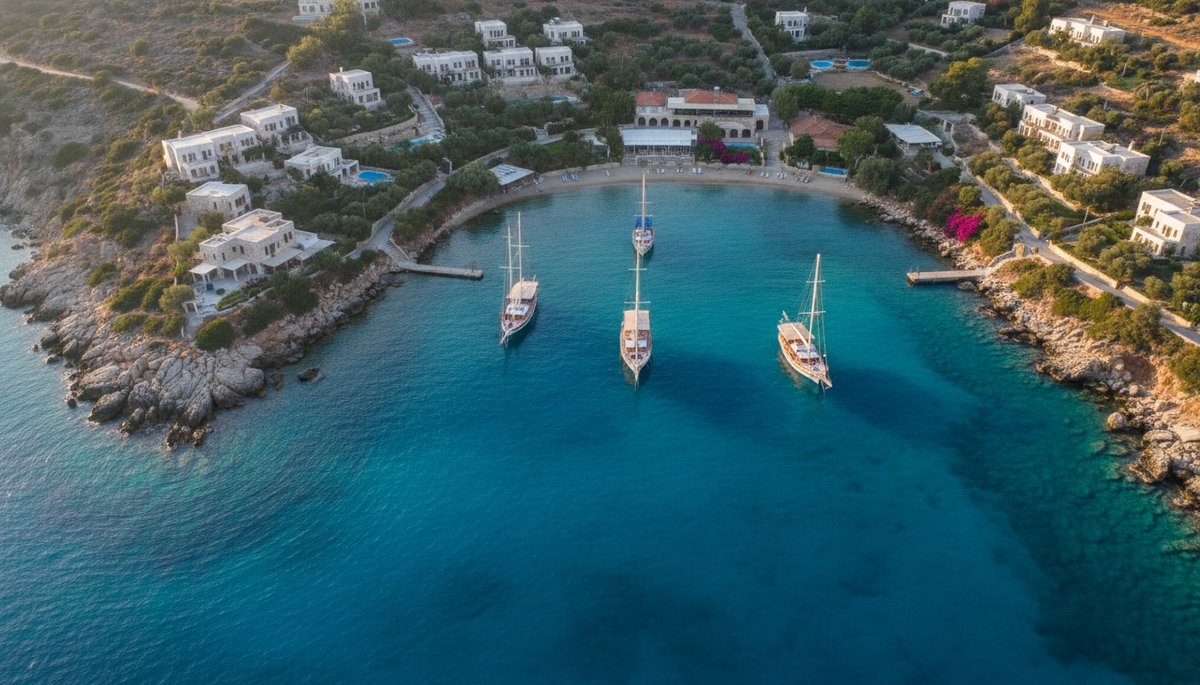
That number reflects something real. Bodrum sits on a peninsula where the Aegean meets the Mediterranean, giving it turquoise water and whitewashed architecture that photographs exactly like Greece — at meaningfully lower prices on most categories including accommodation and dining. The Bodrum Castle (Castle of St. Peter) anchors the old town, and a string of quieter villages — Yalikavak, Turkbuku, Gumusluk — each have their own character along the peninsula coast.
For remote workers: Bodrum has fiber internet in most modern apartments and several coworking spaces in the town center. The average broadband speed is in the 50–100 Mbps range, and Turkish mobile networks (Turkcell, Vodafone TR) are reliable throughout the peninsula. It is a genuine option for a working week.
Safety note: As of June 9, 2026, the US State Department rates Turkey at Level 2 (Exercise Increased Caution). Bodrum, Antalya, Istanbul, and other major tourism areas are well away from the Level 4 zone (within 10 km of the Syria/Iraq border). Tourist infrastructure operates normally. Check the State Department advisory before you book and enroll in STEP.
Best season: June and September dodge both the peak August heat and the highest summer prices. The Turquoise Coast sailing season runs May through October, and a gulet charter from Bodrum into the bays around Bozburun or Gocek is the classic way to see the coast without a crowd.
Where to Go Instead of Santorini? The Lesser Greek Islands That Actually Deliver
The two islands that consistently come up as the best Santorini alternatives are Milos and Naxos, and they earn that reputation.
Milos has 73 beaches and a volcanic coastline of white rock formations and hidden sea caves that directly rivals Santorini's geology. The famous Sarakiniko Beach — white pumice formations dropping into an impossibly blue sea — is the most-shared image, but Milos has dozens of bays that see almost no visitors. The island is small enough to loop by scooter in a day, and the cuisine (the local fish tavernas near Pollonia) is as good as anywhere in the Cyclades.
Naxos is the largest Cyclades island and offers the best all-around balance for a longer stay: proper sand beaches (something Santorini largely lacks), mountain villages with Byzantine churches, excellent local cheese and produce, and a port town lively enough in the evenings but not overwhelmed by cruise ships. June and September are the sweet spots for warm water and thinner crowds compared to peak July and August.
For remote workers: The honest answer is that Greek island Wi-Fi is inconsistent outside of Athens. Mykonos clocks around 15 Mbps in reported nomad data — other islands are similar or slower. For a working week, treat the islands as an inspiration base and keep a local SIM with a data plan as your primary connection. A regional eSIM that covers Greece without roaming charges is practical insurance.
Cost vs. Santorini: Accommodation and dining on Milos and Naxos run noticeably lower than Santorini's July highs, particularly if you book apartments outside the main port areas and eat where locals eat. Avoid August if budget is a priority — demand spikes across all Cyclades.
What Is the Albanian Riviera — and Is It the Cheapest Mediterranean Option?
The Albanian Riviera is a stretch of Ionian coastline in southern Albania running from the Greek border town of Saranda north through villages like Ksamil, Himara, and Dhermi. The water quality is comparable to Greece — the same Ionian Sea, the same turquoise color — and it comes at dramatically lower prices.
Research into Albania travel costs for 2026 puts two mid-range travelers at roughly €100–180 per day combined, covering a 3-star guesthouse, restaurant meals, and transport. Summer apartment rental in Ksamil or Riviera villages runs €60–120 per night for a basic unit, rising to €150–250 for beachfront in peak August. That compares favorably against Greek island prices for similar quality.
The tourism narrative — "like Greece, half the price" — holds up in broad terms. One important qualifier: the Albanian Riviera is a developing destination. Road quality varies, high season brings real crowds to the most popular beaches (especially Ksamil), and some coastal infrastructure is still catching up.
For remote workers: Sarandë is the most practical base. It has the best accommodation variety and the most reliable urban internet. Albania has 4G across most coastal towns; 5G is available in Tirana but not consistently on the Riviera. Dedicated coworking spaces are scarce, so plan to work from your accommodation. Digital nomads on a longer stay can pursue Albania's long-stay residence pathway, though there is no officially branded "digital nomad visa" — worth checking countries with active digital nomad visas in 2026 before making plans.
Safety note: The US State Department rates Albania at Level 2 (Exercise Increased Caution, last updated December 2024), the same level as France, Italy, and the UK. The primary concern flagged is organized crime and targeted violence between drug networks — crime against tourists is overwhelmingly limited to pickpocketing in busy areas. The Albanian Riviera, Saranda, and Ksamil are the main tourist corridors and are considered safe for visitors. A US Embassy security alert issued in April 2026 advised general vigilance in crowded public spaces; check current conditions before travel.
Where Are the Quieter Croatian Islands in 2026?
Dubrovnik is beautiful and exhausting in equal measure by July — the cruise-ship crowds in the old town are now their own kind of attraction. The smarter play is to use Split as a base and ferry to the islands, where the pace drops instantly.
Korcula is the most recommended quieter Dalmatian alternative. It is notably calmer than Hvar (which draws the party crowd), offers an excellent old town, some of Croatia's best wine (Posip and Grk are local whites worth trying), and a pace that allows you to actually be somewhere rather than navigate it. Even in July, Korcula is "busy but not Hvar-busy."
Vis is the most remote option — this was a closed military island until 1989, and it retains an authenticity the more accessible islands lost years ago. There are no large resorts, the fishing villages of Vis Town and Komiza feel genuinely local, and connectivity (fiber in town) is reported as reliable enough for remote work. The tradeoff is that getting to Vis takes more time from Split, and there is less variety in accommodation and food compared to Korcula.
For remote workers: Croatian islands in season have reliable 4G, and a local SIM or regional eSIM covers any gaps in café Wi-Fi. Korcula has more accommodation variety for a week-long stay. Plan your working week around the slower morning hours — the islands warm up fast by noon and the afternoons are better saved for the water. Croatia ranks in the top 10 digital nomad destinations globally for 2026, and its official digital nomad visa (requires approximately €3,300 per month in income) is one option for longer stays.
If you're comparing costs with your options, our guide to cheapest places to work remotely this summer breaks down the numbers across regions.
Getting there and safety: Croatia is EU-member (though not Schengen for some border purposes), visa-free for US citizens for 90 days. Ferry connections from Split to Korcula take around 2.5–3 hours; to Vis, about 2 hours. The US State Department has no specific advisory for Croatia beyond standard travel awareness.
Why Sicily Over the Amalfi Coast in 2026?
The Amalfi Coast is one of the most stunning places in Italy. It is also one of the most logistically frustrating — the narrow coastal road means traffic and ferry queues are constant in summer, accommodation in the cliffside villages is among Italy's most expensive, and the experience can feel stage-managed rather than real.
Sicily solves most of those problems. It is a large island with diverse geography: the Baroque south (Syracuse, Ragusa, Modica), the active volcano (Etna), the dramatic western coast (Trapani, Marsala), and Palermo as a proper, lived-in city with food markets and contemporary culture. The pace is slower than the Amalfi circus.
On cost: Research into 2026 travel budgets puts a mid-range day in Sicily at roughly €80–150 per person including accommodation and meals. The comparable mid-range Amalfi day runs €150–300. Sicily consistently undercuts the Amalfi Coast by around 40–60% on most line items — and dramatically more if you avoid the July–August peak.
For remote workers: Palermo is the most practical base, with a growing coworking scene (BeetCommunity coliving, Piano C, Magnisi) and consistent fiber internet. Catania also has options. Note that the coworking culture is still developing outside the cities — if you're planning to work from a rural agriturismo near Agrigento, check connectivity before you commit. Palermo hosted Italia Nomad Fest 2026 in March, a signal that the city is actively courting the remote-work crowd.
Getting there: Direct flights from major US hubs to Palermo or Catania are limited — most routes connect through Rome, Milan, or a Northern European hub. Budget for this when comparing costs against the Amalfi, which also typically requires a Naples connection. Once in Sicily, renting a car unlocks the whole island; the southwest coast in particular sees very few tourists.
How to Island-Hop the Mediterranean: Keep One eSIM for All of It
A Med-hopping itinerary — say, Istanbul to Bodrum ferry, then Dodecanese islands, then a short flight to Tirana and the Riviera — crosses multiple country networks. Keeping a separate local SIM for each country is the old way. A regional eSIM that covers 42 European countries (including Turkey and Greece) in a single plan is cleaner.
Airalo's Europe eSIM covers all the countries in this guide — Greece, Turkey, Croatia, Albania, and Italy — under one plan, starting at $11.50 for 3 days of unlimited data up to $72 for a 30-day unlimited plan. No SIM-swapping, no roaming surprises at border crossings.
Affiliate disclosure: The link below is a tracked affiliate link — we may earn a small commission at no extra cost to you.
You can browse Airalo's Europe eSIM plans at Airalo Europe eSIM — the plan activates when you connect to a supported local network, so you can set it up before you leave.
For the full picture on remote-friendly destinations beyond the Med, our round-up of best summer remote work destinations covers options across multiple regions.
Plan Your Mediterranean Alternative Trip
The pattern across all five picks in this guide is the same: the "second choice" gives you most of what drew you to the famous name — the light, the water, the food culture — while cutting the crowd pressure and, in most cases, the cost.
A few practical notes before you book:
Albania requires crossing from Greece (Corfu to Saranda ferry is 35 minutes) or flying into Tirana. The Riviera is easiest reached by car from Tirana or by ferry from Corfu.
Bodrum is served by Bodrum-Milas Airport (BJV). Turkish Airlines and other carriers connect from major US hubs via Istanbul.
Sicily airports: Palermo (PMO) and Catania (CTA). Budget for at least one European connection.
Croatian islands require a ferry from Split or Dubrovnik. Split (SPU) has better international connections and is the smarter gateway.
Greek islands are reached by Athens (ATH) or direct summer charters from some US cities. Ferry schedules from Piraeus and Rafina cover both Milos and Naxos.
Check shoulder-season windows — June (especially the second half) and September — for the best combination of warm weather, reasonable prices, and crowd levels across all five picks.
Frequently Asked Questions
What are the best alternatives to Santorini for 2026?
Where can I go in the Mediterranean to avoid crowds in summer 2026?
Is Bodrum worth visiting in 2026?
What are the cheapest Mediterranean destinations in 2026?
Which Mediterranean second cities have good internet for remote work?
You Might Also Like
Travel + Remote Work Briefing — October 18, 2026
Travel + Remote Work Briefing — October 17, 2026
Travel + Remote Work Briefing — October 15, 2026