Europe Flight Chaos 2026: Strikes & Your Rights
Europe Flight Chaos 2026: Strikes & Your Rights
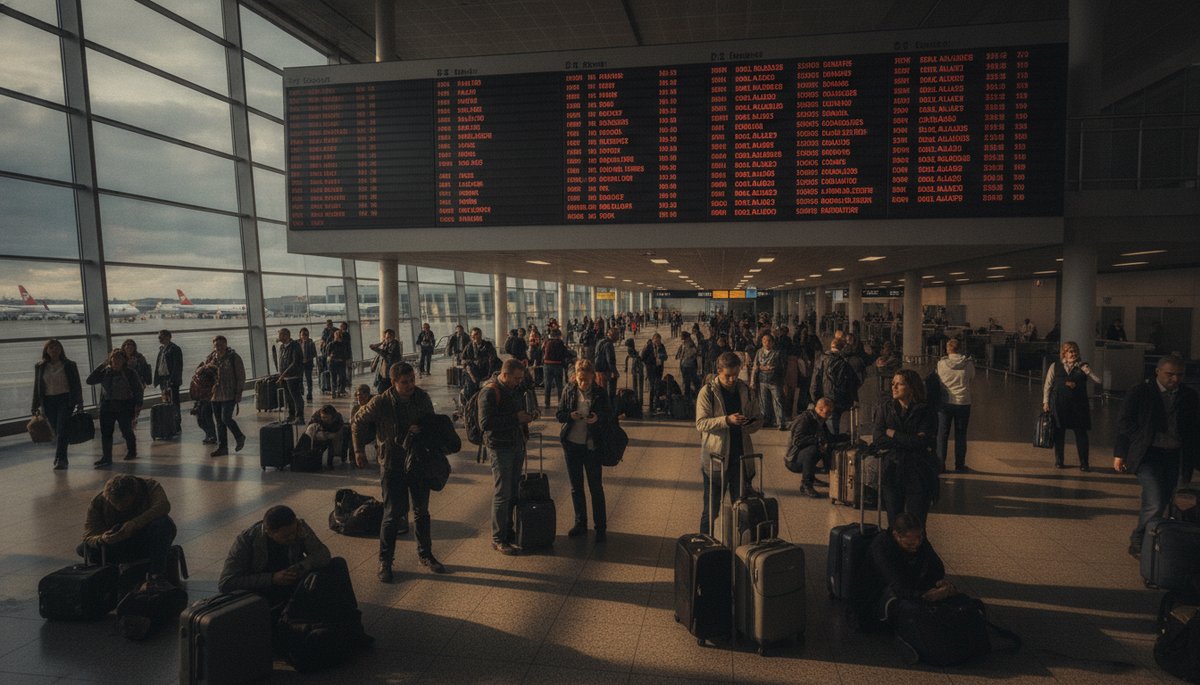
If you have a Europe trip booked this summer, you need to read this before you fly. Coordinated labor actions across Spain, France, Italy, and Belgium are making Europe flight delays 2026 a genuine planning risk — not a minor inconvenience but a wave of disruptions that has already stranded thousands of passengers at CDG, Rome Fiumicino, and Madrid.
Quick Answer: Europe's summer 2026 flight disruption risk is elevated across multiple countries, with confirmed strikes running through at least late July. Under EU261, airlines owe you a full refund or rebooking plus meals and a hotel regardless of strike type. Cash compensation (€250–€600) is only owed when the airline's own staff strikes — not when air traffic control or airport workers walk out. The reform deal reached June 15, 2026 strengthens several rights but will not be law until approximately 2027.
Disclosure: This post contains affiliate links. If you make a purchase through these links, we may earn a small commission at no extra cost to you. We only recommend products we genuinely believe in.
Are There Flight Strikes in Europe This Summer?
Yes, and the strike calendar is more crowded than in any recent summer. Spain, France, Italy, and Belgium have all seen aviation labor actions in 2026, with some still active and others scheduled into late July.
Spain is the longest-running situation. On April 17, 2026, the USCA union and CCOO jointly called an indefinite strike at SAERCO, a private air navigation service provider that manages 14 Spanish airport towers — including Lanzarote, Fuerteventura, Seville, and Vigo. As of late June 2026, no agreement had been reached and the dispute had already run more than 70 days. The main Madrid Barajas (MAD) and Barcelona El Prat (BCN) towers are not operated by SAERCO, so the largest Spanish hubs face lower direct impact — but ripple effects on inbound and outbound capacity are real.
Italy is the country with the most confirmed forward strike dates. A multi-layered walkout hit on June 26, 2026 (nationwide ground handling). Two further dates are confirmed: July 5, 2026 brings a 24-hour strike by ground-handling workers (CUB Trasporti) at all Italian airports, a simultaneous ENAV ATC strike at the Milan Area Control Centre, and a security-staff walkout at Rome Fiumicino from 10:00 to 18:00. July 21, 2026 brings a 24-hour ground-handling strike at Milan Malpensa by Alha and MLE-Bcube workers — limited to Malpensa, not a nationwide action. Italian law requires minimum-service protection during aviation strikes: flights are generally guaranteed during the morning band (07:00–10:00) and evening band (18:00–21:00 local time) under Law 146/1990, though these protected bands apply to ATC and crew strikes — not to ground-handling actions such as the CUB Trasporti July 5 walkout or the July 21 Malpensa action, where no protected windows exist.
France saw a 24-hour strike by ground-handling and security staff at the three Paris airports — CDG, Orly, and Le Bourget — on June 18, 2026. Air France and easyJet were among the most exposed carriers; both issued booking waivers, though formal proactive cancellation notices were not confirmed in advance of the strike. Note that the widely reported figure of 3,283 flight delays across European airspace refers to June 15, 2026 — a separate pre-strike disruption day — not to the June 18 strike itself.
Belgium experienced two unannounced walkouts by Skeyes air traffic controllers on June 2, 2026, effectively shutting Belgian airspace for several hours. A short-term deal paused the action on June 3, but the underlying pay dispute is unresolved.
The pattern is structural: low-cost-carrier capacity expansion, post-pandemic pay disputes, and peak-summer staffing pressure combine every year. 2026's wave is particularly synchronized across borders.
What Is EU261 and Who Does It Protect?
EU Regulation 261/2004 is the law that sets out what European airlines must do for you when flights go wrong. It applies to:
All flights departing any EU member-state airport — regardless of the airline's nationality or your nationality
Flights operated by EU-based carriers arriving at an EU airport — so if you fly Air France from New York to Paris, you are covered on that inbound leg
Norway, Iceland, and Switzerland are also covered despite not being EU members
If you are flying a non-EU carrier (Delta, American, United) into an EU airport, the outbound leg is covered but the inbound transatlantic leg is governed by US rules, not EU261.
UK travelers should know that flights departing UK airports fall under the equivalent UK261 rules, which mirror the EU framework but use fixed sterling amounts of £220, £350, and £520 — set independently in pounds, not a direct euro conversion. Flights departing EU airports on any carrier are covered by EU261 regardless of the passenger's nationality.
How Much Compensation for a Delayed Flight in Europe?
Under current EU law — unchanged by the June 2026 reform deal — the amounts are fixed by distance:
Flight distance | Compensation |
|---|---|
Up to 1,500 km | €250 per person |
1,500–3,500 km (or intra-EU over 1,500 km) | €400 per person |
Over 3,500 km | €600 per person |
The trigger: your arrival at the final destination must be 3 or more hours later than scheduled. Departure delays that make up time in the air and land within 3 hours do not qualify.
Reduced compensation: if an airline reroutes you and you arrive within 2 to 4 hours of your original arrival time (depending on distance), the airline can halve the payment.
These numbers were set in 2004. The June 15, 2026 provisional reform deal reached by the European Parliament and the EU Council left the amounts unchanged, though it strengthened surrounding protections (more on that below). The reform is not yet law — it must still pass a formal Parliament vote expected in July 2026 and then enter a transposition period that will push implementation to approximately 2027.
Which Strikes Pay Compensation — and Which Do Not?
This is the most important distinction to understand before your trip, and the one airlines count on you not knowing.
Airline own-staff strikes: compensation is owed. If the pilots, cabin crew, or ground-handling staff employed directly by your airline walk out, that is not considered an "extraordinary circumstance" under EU261. A landmark 2018 European Court of Justice ruling established this principle clearly: the airline bears the risk of its own labor relations. You are entitled to both care rights and cash compensation.
Air traffic control or airport-authority strikes: cash compensation is not owed. Walkouts by air traffic controllers (like France's DSNA/SKEYES or Spain's SAERCO), airport security staff employed by the airport authority, or third-party ground handlers are treated as events outside the airline's control. The airline does not owe cash compensation. However — and this matters — your refund and care rights are fully intact no matter what type of strike caused the disruption.
In practice, this means:
A strike by Ryanair's own Spanish crew: Ryanair owes you €250–€600 plus meals and hotel
A strike by SAERCO ATC at Seville airport: the airline owes you meals, hotel, and the choice between a full refund or rebooking — but no cash compensation
The June 2026 reform deal codifies a standardized list of extraordinary circumstances directly into the regulation text, ending some of the legal gray area around what counts. Until that reform takes effect, the existing ECJ case-law approach continues to apply.
What Are Your Care Rights? (These Always Apply)
Regardless of whether the disruption qualifies for cash compensation, airlines must provide care as soon as the delay reaches a threshold:
2 hours for short-haul flights (≤1,500 km)
3 hours for medium-haul EU flights and some international routes
4 hours for longer international routes
Care must include meals and refreshments appropriate to the waiting time, two free phone calls or equivalent communications, and — if an overnight stay becomes necessary — hotel accommodation and transfers between the airport and hotel.
If the airline does not provide this and you pay out of pocket, keep your receipts. You can claim reimbursement from the airline. This applies even during an ATC strike.
Can I Get a Refund If My Flight Is Cancelled Due to a Strike?
Yes, always. Refund and rebooking rights under EU261 are unconditional — they do not depend on whether the cancellation was an extraordinary circumstance.
When an airline cancels your flight (or you face a delay long enough that you choose not to travel), you have three options:
Full refund of the ticket price, including unused segments, paid within 7 days
Rerouting at the earliest opportunity on the airline's next available flight or a partner carrier's service
Rerouting at a later date of your choice, subject to available seats
One important rule: if you are stranded on a multi-leg itinerary, the airline must also refund and fly you back to your original departure point if you choose not to continue.
The coming self-reroute right (reform, not yet law): the June 2026 deal introduces a new right — if the airline cannot reroute you within three hours of your original departure time, you may arrange your own alternative transportation and claim back up to 400% of your original ticket price. This provision is part of the reform and is not in force today, but it is worth knowing for trips that extend into 2027 and beyond.
What to Do Right Now: A Pre-Trip Checklist
Planning a Europe trip this summer? Here is the practical prep that matters:
Before you book:
Check whether your route passes through a high-risk country (Italy, Spain, and France are the current hotspots) and what the specific strike dates look like
Book directly with the airline rather than third-party platforms — refunds are faster and rerouting options more straightforward
Consider travel insurance that explicitly covers strike-caused cancellations; not all policies do. Compare terms carefully (SafetyWing and other nomad-focused insurers are worth checking editorially, though terms vary by policy)
Check your credit card's travel protection — some premium cards offer trip cancellation/interruption cover that stacks with EU261
Before you fly:
Screenshot or download your booking confirmation and ticket receipt — you will need proof of original times and fare paid to file any claim
Photograph any care services the airline provides (or fails to provide) at the airport
Keep all receipts if you buy meals or accommodation that the airline should have covered
At the airport if your flight is cancelled:
Go to the airline desk and choose between a refund or rerouting — do not accept a voucher unless you genuinely want one
If the airline cannot get you on a same-day flight, ask explicitly for hotel accommodation and transfers; many passengers are not proactively offered this
Ask for written confirmation of the cause of cancellation — this matters for claims
Staying connected if stranded: disruption scenarios are exactly when you need reliable data most — to rebook, find hotels, and notify anyone depending on your schedule. An eSIM like the Airalo Eurolink plan covers 42 European countries on a single plan, so if you get rerouted through a different country entirely, you stay online without scrambling for a local SIM. You can install it before you leave home. It is also useful for the kind of multi-country European trip where the strike risk is highest. (Affiliate link — we may earn a commission at no extra cost to you.)
For more on staying covered during Europe trips, see our guide to staying connected and insured while working abroad.
How to File an EU261 Claim
Airlines are required to notify you of your compensation rights — this is one of the changes codified in the June 2026 deal, requiring airlines to send written notification within 4 days of arrival (once the reform takes effect). Under current law, you typically need to initiate a claim yourself.
The process:
File directly with the airline via their website or customer service — most have a dedicated claims or passenger rights form
Airlines must acknowledge receipt of your claim (this is a reform requirement) and must pay within 30 days of the agreed deal's entry into force; under current law, timelines are less standardized
If the airline ignores or wrongly denies your claim, escalate to the designated National Enforcement Body (NEB) in the country where the disrupting flight departed — each EU country has one; the full list is published on the European Commission's passenger rights pages at transport.ec.europa.eu. Common examples include ENAC in Italy, DGAC in France, AESA in Spain, and the CAA in the UK
As a last resort, EU261 claims are enforceable in the national courts of the departure country; several no-win-no-fee claim services operate across Europe if you prefer that route
Document everything: your original booking, your boarding pass, any messages from the airline about the cancellation, and receipts for any out-of-pocket expenses.
The EU261 Reform: What It Means (and When)
The June 15, 2026 provisional deal between the European Parliament and the Council of the EU is the first significant overhaul of EU passenger rights since the original 2004 regulation. After 13 years of stalled negotiations, here is what was agreed:
What stays the same: compensation amounts (€250/€400/€600), the 3-hour arrival delay trigger, and the basic extraordinary-circumstances framework.
What changes (once in force, expected ~2027):
Airlines must notify passengers in writing within 4 days that they may be owed compensation, with clear filing instructions
Airlines must acknowledge claims on receipt and pay within 30 days or provide a written reason for refusal
If the airline cannot reroute you within 3 hours of the original departure, you may self-reroute and claim up to 400% of the ticket price
The base ticket price must include one cabin bag — no more separate carry-on fees
Airlines cannot deny boarding on a return leg because a passenger no-showed for the outbound
What is not yet law: none of this applies to flights disrupted today. The deal still needs a formal Parliament vote (expected July 2026) and must then be formally adopted and transposed — a process that takes until approximately 2027.
For summer 2026 trips, the current 2004 rules apply in full. Know them and you are far better positioned than most travelers at the check-in desk.
Beyond the Strike Risk: The Bigger Summer Picture
Flight chaos is not only a strike story. Europe is also experiencing record fare pressure from high fuel costs and strong post-pandemic demand, particularly on transatlantic routes into CDG, FCO, and LHR. Overcapacity at certain hubs during peak weeks in July and August creates conditions where any ATC slowdown cascades quickly.
If you are planning a longer European stay and want to understand the other moving pieces — including the new EES biometric border system going live — check out our guide to EU EES border changes for digital nomads in 2026. And if a strike-season disruption makes you reconsider where to base yourself, our roundup of digital nomad visa options across Europe covers the countries where slow-travel is now easiest with the right legal status.
The Bottom Line
Europe flight delays 2026 are a real risk, especially on routes through Spain, Italy, and France in July. Knowing your EU261 rights puts you in a fundamentally stronger position than the average passenger who only discovers the rules after the flight board goes red.
The three things to remember:
Refund and care rights always apply — regardless of who caused the strike
Cash compensation (€250–€600) only applies when the airline's own staff causes the disruption — not ATC or airport worker strikes
The June 2026 reform deal is not yet law — summer 2026 trips are governed by the original 2004 rules, which are still solid protection when you know how to use them
Book smart, document everything, and keep your digital toolkit ready. A delay is an inconvenience; being the passenger who knows what to demand turns it into a manageable one.
Frequently Asked Questions
Are there flight strikes in Europe this summer 2026?
How much compensation for a delayed flight in Europe?
What is EU261?
Can I get a refund if my flight is cancelled due to a strike?
Does EU261 apply to US and UK travelers flying in Europe?
You Might Also Like
Travel + Remote Work Briefing — September 9, 2026

Travel + Remote Work Briefing — September 8, 2026

Travel and Remote Work Briefing — September 7, 2026