Africa Digital Nomad Frontier: Best Hubs 2026
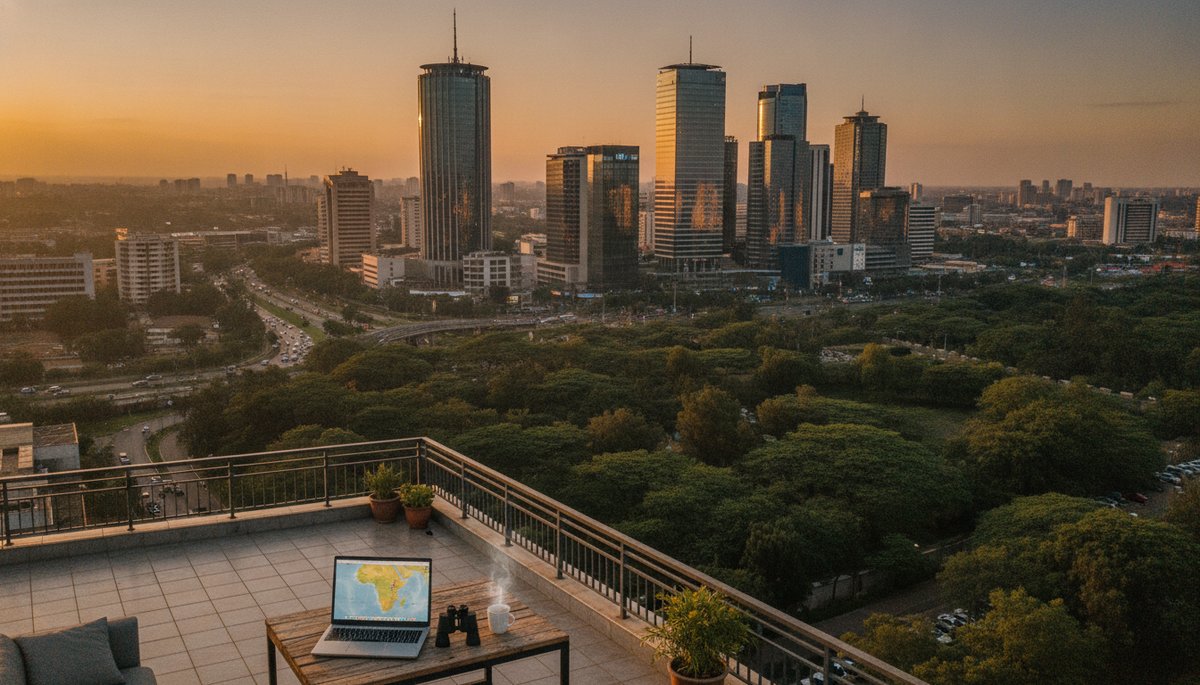
Africa Digital Nomad Frontier: Best Hubs 2026
Bali is crowded. Spain's Málaga has waitlists at every coworking space. Meanwhile, a quieter conversation is picking up on nomad forums: Africa.
Not "Africa" in a vague sense — specific cities with fast fiber, time zones that overlap with Europe and the Middle East, new remote-work visas, and a cost of living that makes Lisbon look expensive. Kenya, Mauritius, South Africa, Namibia, and Cape Verde have all made deliberate moves to welcome remote workers in the last two years. This guide covers what each destination actually offers, what their visas require, and what you need to know before you pack a laptop.
Quick Answer: Africa's strongest digital nomad hubs in 2026 are Cape Town (best infrastructure, 3-year visa), Nairobi (cheapest with a formal visa, lowest cost), Mauritius (easiest visa, island lifestyle), Namibia (wildlife + remoteness, 6-month visa), and Cape Verde (Atlantic islands, EU-timezone alignment, no income tax on foreign earnings). Every destination here has a formal remote-work permit — no more tourist-visa workarounds.
Disclosure: This post contains affiliate links. If you make a purchase through these links, we may earn a small commission at no extra cost to you. We only recommend products we genuinely believe in.
Why Are Digital Nomads Looking at Africa in 2026?
Several forces are pulling nomads toward African hubs at the same time.
The established spots have hit friction. Bali introduced a new 60-day tourist visa structure that limits back-to-back extensions. Lisbon and Barcelona have seen rents spike sharply under nomad pressure. Thailand's 180-day Digital Nomad Visa (DTV) remains popular, but Southeast Asia time zones make synchronous work with European clients challenging. If you're based in Europe or work with European companies, Africa's overlap is compelling: Nairobi is UTC+3, Cape Town is UTC+2, and Mauritius is UTC+4 — all within easy video-call hours of London, Paris, and Berlin.
Visas are real now. Three years ago, most digital nomads in Africa were operating on tourist visas and hoping no one asked questions. That era is ending. Kenya, South Africa, Namibia, and Cape Verde all have specific remote-work permit categories on the books in 2026. Mauritius' Premium Visa has been running long enough that nomads have renewal experiences to report. The legal infrastructure caught up.
The price gap is real. A comfortable month in Nairobi — including a furnished apartment, coworking desk, food, and local transport — runs roughly USD 1,000 to 1,800. That's comparable to Chiang Mai circa 2018, not Bangkok 2026. Cape Town is pricier but still significantly cheaper than Western Europe for the lifestyle it offers.
If you've been curious but weren't sure whether these destinations are "ready," the short answer for 2026 is: most of them are.
What Is the Kenya Digital Nomad Visa and What Does It Require?
Kenya's Class N Digital Nomad Work Permit is a formal, dedicated visa category for remote workers, introduced through Kenya Citizenship and Immigration regulations in October 2024 and amended in December 2024 to lower the income threshold.
Who qualifies: Freelancers, employees of companies registered outside Kenya, or shareholders or directors of foreign entities who work remotely from within Kenya.
Income requirement: The regulations specify an assured annual foreign income of USD 24,000 (equivalent to USD 2,000/month), reduced from the prior threshold of USD 55,000 under the December 2024 amendment. Note that some Kenyan immigration practitioners treat USD 24,000 as a benchmark rather than a hard floor, with the core requirement being demonstrable, stable foreign income. Confirm the current enforcement standard at fns.immigration.go.ke or with a Kenyan immigration lawyer before applying. Documentation typically required: three months of bank statements or payslips from a foreign employer showing consistent income.
Fees and validity: Processing fee of USD 200 (non-refundable) plus an issuance fee of USD 1,000 per year. The permit is issued for one to two years, renewable. Apply via the Kenya eFNS portal at fns.immigration.go.ke.
On the ground in Nairobi: Nairobi's Westlands and Kilimani neighborhoods are the nomad epicenter. Coworking desks run roughly KES 10,000–20,000 (approximately USD 90–180) per month at spaces like Nairobi Garage and Ikigai. A furnished 1BR apartment in those neighborhoods costs around USD 500–800/month. All-in monthly budget: USD 1,000–1,800 for a comfortable life.
Internet: Fiber is well-established in Nairobi's business districts. Mobile data (Safaricom, Airtel) provides a solid 4G backup. Speeds outside the city vary significantly — build your base in Westlands or Kilimani, not a rural guesthouse, if consistent connectivity matters.
Safety note: Nairobi is a major city with the full range of urban risks. Westlands and Kilimani are expat-popular and generally considered safe for day-to-day living; exercise standard urban caution after dark, use app-based taxis (Uber/Bolt) rather than unmarked cabs, and check your country's travel advisory before you go.
For a broader look at what remote-work visas exist globally, our digital nomad visa tracker for 2026 covers over 40 countries.
Is the Mauritius Premium Travel Visa Good for Digital Nomads?
Yes — and it might be the easiest formal digital nomad visa in Africa to obtain.
The Mauritius Premium Travel Visa is valid for 12 months, renewable, and issued free of charge (no government processing fee). Applications go through an online portal and are typically processed within 48 hours on business days.
Income requirement: A minimum of USD 1,500 per month in foreign income paid into your bank account. You'll need bank statements or an employment contract demonstrating this. The main restriction: you cannot enter the Mauritius local labor market; all income must come from outside the country.
Cost of living: Mauritius is more expensive than Nairobi or Windhoek but is manageable on a remote income above the visa floor. Outside Port Louis and the tourist coastal zones, a comfortable nomad life runs roughly USD 1,000–1,500/month including accommodation. Inside the resorts, it's more.
What makes Mauritius compelling: The island is genuinely beautiful, politically stable, and a very easy administrative environment for foreigners. English and French are widely spoken. The UTC+4 time zone works well for EU and UAE client calls. The airport connects directly to most major European cities.
What to be honest about: Mauritius is a small island. If you need the energy of a large city, a buzzing tech scene, or a huge nomad community, it may feel limiting after a few months. It's an outstanding choice for a focused 3–6 month stretch, less so as a permanent hub.
South Africa Remote Work Visa: Is Cape Town Worth It?
South Africa's Remote Work Visitor Visa (officially under Section 11(1)(b)(iv) of the Immigration Act) allows foreign nationals to live in South Africa for up to three years while earning from foreign employers or clients.
Income requirement: A minimum gross annual income of ZAR 650,796, as mandated by the Department of Home Affairs effective 9 October 2024 (Government Gazette No. 51416). At current exchange rates, that's roughly USD 35,000–37,000 per year — notably higher than Kenya or Mauritius. You'll need three months of bank statements demonstrating this income level. Application fee: ZAR 425 payable to Home Affairs.
Processing time: Six to ten weeks. Apply at a South African embassy or consulate in person.
Tax note (important): If you spend more than six months in South Africa within a 36-month period, you may be required to register with the South African Revenue Service (SARS). Holders on shorter stays may seek exemptions, but confirm with a tax advisor before committing to a long stay.
On the ground in Cape Town: Cape Town is arguably the best-resourced digital nomad city in Africa right now. The coworking scene in the CBD, Green Point, and Woodstock is dense. Internet speeds are strong, with fiber widely available. A one-bedroom apartment in the city center averages around USD 910/month; outside the center, roughly USD 455/month. A comfortable nomad budget: USD 1,200–1,800/month depending on lifestyle. The city ranked 6th globally for digital nomads in a 2025 ranking, citing its fast Wi-Fi, thriving tech community, and outdoor lifestyle.
Safety framing: Cape Town gets a lot of media attention for crime. A realistic read: tourist and nomad-popular areas (the CBD, Green Point, Camps Bay, Woodstock) have an active presence and strong expat community. Exercise standard urban vigilance, avoid walking alone at night in less-trafficked areas, and use Uber rather than street-hail taxis. Ask your accommodation or coworking space for neighborhood-specific advice — local guidance is more useful than generic headlines.
Does Namibia Have a Digital Nomad Visa in 2026?
Yes. Namibia's digital nomad visa is a six-month stay permit aimed specifically at remote workers.
Income requirement: A minimum monthly income of USD 2,000 from sources outside Namibia (rising to USD 3,000 if you include a spouse). You'll need six months of bank statements. The visa fee is NAD 3,300 (approximately USD 180 at mid-2026 rates). Applications are submitted to the Namibia Investment Promotion and Development Board (NIPDB) at [email protected].
On the ground: Windhoek is the base. It's a small, navigable capital — genuinely clean, well-organized, and considerably less intense than Nairobi or Cape Town. Internet connectivity in Windhoek's business areas is workable for remote work, though Namibia's national broadband averages are modest by global standards — around 40 Mbps by some estimates, with business-district speeds generally higher. A comfortable single-person life in Windhoek runs USD 900–1,100/month.
Who Namibia is for: Nomads who want genuine wilderness access as part of their setup. Namibia has some of the most stunning landscapes on the planet — Sossusvlei, Etosha, the Skeleton Coast — all within reach of a long weekend. It is not for nomads who need a dense tech community, frequent flights, or big-city energy. The nomad community is small but tight-knit.
Six months is the limit — there is no current renewal pathway to extend the visa for a longer stay. Plan accordingly.
What Is Cape Verde's Remote Working Program?
Cape Verde (officially Cabo Verde) runs a Remote Working Program that offers up to six months of legal remote-work residence, with renewal options.
Eligibility: The program is currently open to citizens of European countries, North America, Community of Portuguese-Speaking Countries (CPLP), and Economic Community of West African States (ECOWAS/CEDEAO) nations.
Income requirement: You must demonstrate a monthly bank balance of at least EUR 1,500 (individual) from foreign sources, rising to EUR 2,700 for families. Proof of health insurance covering the first 30 days is also required. Application fees are modest — approximately EUR 20 to apply, plus EUR 34 on arrival.
Key benefit: Holders are granted temporary residency status but are not considered tax residents of Cape Verde, meaning foreign-earned income is exempt from Cape Verdean income tax during your stay.
On the ground: Cape Verde is a cluster of ten Atlantic islands off West Africa — closer geographically to West Africa but with a Portuguese-creole culture, stable democracy, and direct flights from Lisbon, Amsterdam, and London. Time zone UTC-1 is slightly west of London, making it ideal for US East Coast overlap. The trade-off versus Mauritius: smaller, fewer flights, and the island infrastructure varies significantly between islands (Santiago and Sal are the best-connected for nomads).
Staying Connected Across Africa
One logistical wrinkle when hopping between African hubs: SIM cards. Getting a local SIM in Kenya is easy; crossing to South Africa means a new SIM; heading to Mauritius means another. For nomads covering multiple destinations in one trip, juggling plastic cards is a minor but real friction.
The cleaner solution is an Airalo Africa regional eSIM, which covers around 36 African countries on a single profile — Kenya, South Africa, Mauritius, and more, with no SIM swap at any border. Install it before you leave home, activate on arrival, and keep your home SIM for calls and WhatsApp. (Affiliate link — we may earn a commission at no extra cost to you.)
For more on planning your comms and insurance setup before a long trip, see our guide to staying connected and insured while working abroad.
SafetyWing's Nomad Insurance is worth researching for health and travel cover in this region — it is designed for location-independent workers and covers multiple countries without the gaps that standard travel insurance creates. (We have no affiliate relationship with SafetyWing at time of publication; this is an editorial mention only.)
Is Africa Right for You? An Honest Assessment
Africa's nomad hubs are not for everyone, and honesty about trade-offs is more useful than hype.
Go to Africa if:
You're based in Europe or the Middle East and want time zones that match your clients.
You want lower costs than Western Europe without the 12-hour time shift of Southeast Asia.
You've done Bali, Chiang Mai, and Lisbon and want something genuinely different.
You want wildlife, landscapes, and culture that are legitimately unlike anywhere else on earth.
You want a formal legal status rather than tourist-visa grey zones.
Think twice if:
You need dense nomad communities for daily social life — these are smaller than Bali or Medellín right now.
You work heavily with US West Coast clients and need Pacific-overlap hours — Africa's time zones are the wrong direction.
You're not prepared for power cuts, connectivity variance outside major cities, or occasional bureaucratic friction.
You want a visa in days, not weeks — South Africa's 6-10 week processing is not for last-minute planners.
The single most important piece of advice: research the specific city, not just the country. Cape Town and a remote lodge in the Western Cape are wildly different digital nomad experiences. Nairobi's Westlands is not rural Kenya. Choose your base deliberately.
Before You Go: Quick Checklist
Before committing to any African hub, run through these:
Verify your visa. Requirements and income thresholds change. Check the official immigration portal for your chosen country — not a third-party aggregator — before submitting your application.
Check your country's travel advisory. The US State Department, UK FCDO, and equivalent agencies publish current safety ratings by country and region.
Sort your eSIM before you fly. Having data ready on arrival saves frustration at the airport. See the section above.
Pack for the climate variance. Nairobi sits at 1,700m elevation — it is cooler than you expect. Cape Town in July (Southern Hemisphere winter) is cold and wet. Mauritius and Cape Verde are tropical year-round.
Plan for power cuts (load-shedding). South Africa has had recurring power outages (load-shedding) in recent years. Coworking spaces typically have generators; home apartments often do not. Factor this into your accommodation choice.
Our digital nomad packing checklist covers the gear worth bringing for a longer stint abroad, and if you're comparing Africa's emerging scene with a more established alternative, our working remotely in Southeast Asia guide gives a useful reference point.
Africa is not the easiest nomad region — but it is increasingly ready for remote workers who do their homework. The visas are real, the internet in the major hubs is solid, and the cost-to-experience ratio is genuinely hard to beat in 2026.
Frequently Asked Questions
What is the income requirement for Kenya's digital nomad visa?
Is Cape Town good for digital nomads in 2026?
Which African country is cheapest for digital nomads?
Does Mauritius have a digital nomad visa?
Can I use an eSIM across multiple African countries?
You Might Also Like
Travel + Remote Work Briefing — October 12, 2026

Travel + Remote-Work Briefing — October 11, 2026

Travel + Remote-Work Briefing — October 10, 2026