World Cup 2026 Packing List: 15 Travel Essentials
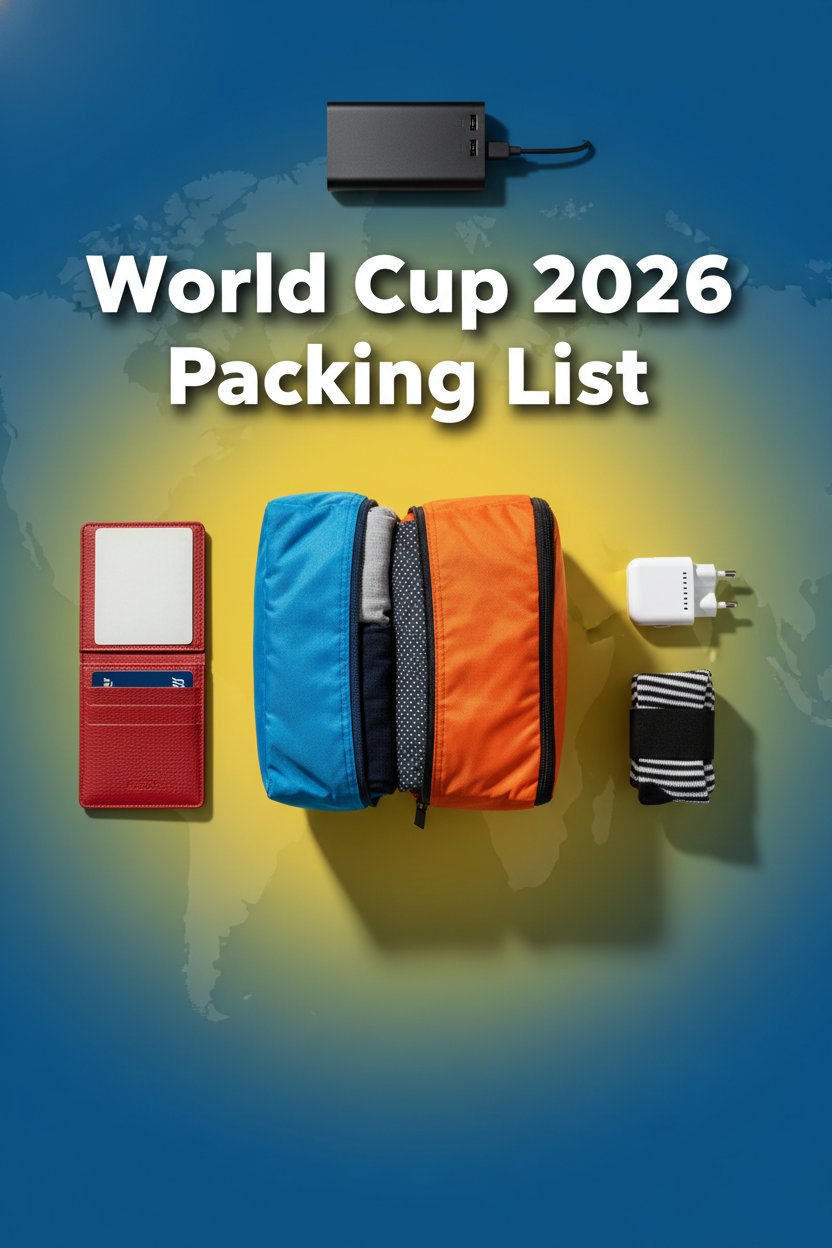
Packing essentials — grab these first
If you buy nothing else for a three-country World Cup trip, start with these five:
- Anker PowerCore 26800 power bank — keeps your phone alive through travel days and 90-minute matches. Check price →
- TESSAN universal travel adapter — one plug for the US, Mexico, and Canada. Check price →
- Apple AirTag — track your bag across border-hopping flights. Check price →
- Eagle Creek compression cubes — fit two weeks into a carry-on. Check price →
- napfun travel neck pillow — survive the long-haul and red-eye legs. Check price →
Affiliate links — we may earn a commission at no extra cost to you. Full 15-item list below.
World Cup 2026 Packing List: 15 Travel Essentials
The 2026 World Cup spans three countries — the United States, Canada, and Mexico — across 16 host cities and 48 group-stage matches starting June 11. Whether you're chasing three games in ten days or blending match days with remote work between venues, you're going to need gear that actually holds up to multi-city travel.
This isn't a "throw everything in a suitcase" list. This is a practical packing list built for people who travel light, move fast, and can't afford to have their phone die two minutes into a penalty shootout.
Quick Answer: For the 2026 World Cup, prioritize a high-capacity power bank, a universal travel adapter, packing cubes, an RFID passport holder, and a luggage tracker. Add compression socks for transit days, a travel neck pillow for long hauls, and a collapsible water bottle for stadium heat. These 15 essentials cover your charging, organizing, security, and comfort needs across all three host countries.
Disclosure: This post contains affiliate links. If you make a purchase through these links, we may earn a small commission at no extra cost to you. We only recommend products we genuinely believe in.
The Full World Cup 2026 Packing Checklist
Before diving into each item, here's the quick-scan list:
High-capacity power bank
Universal travel adapter
Packing cubes
Travel neck pillow
Luggage tracker (AirTag)
Travel router
Digital luggage scale
Compression socks
RFID passport holder / travel wallet
Collapsible water bottle
Printed/digital visa + ticket documentation
Light layers for indoor/outdoor temperature swings
Waterproof day bag or packable tote
Basic first-aid / blister kit
Cash in local currency for each host country
Items 1–10 are affiliate-linked below with honest notes. Items 11–15 are non-gear essentials covered at the end.
Power and Connectivity
1. Anker PowerCore 26800 Power Bank
Your phone is your ticket scanner, navigation system, translation app, and stadium memory card all in one. The worst thing that can happen at a World Cup match is a dead battery.
The Anker PowerCore 26800 holds enough charge to fully refill most smartphones three times over. It's heavy by ultralight standards, but that trade-off makes sense when you're spending 10+ hours away from a power outlet on game days.
Honest note: Check your specific stadium's bag policy before the match. Power banks are often allowed, but some venues have wattage caps. Use it freely at fan zones, hotels, and on transit.
2. TESSAN Universal Travel Adapter
The US, Canada, and Mexico don't all share the same outlet standard — and if you're flying in from Europe, Asia, or South America, your plugs won't work at all without an adapter.
The TESSAN Universal Travel Adapter covers most international plug types and includes USB-A and USB-C ports, so you can charge multiple devices from a single wall outlet. One adapter for the whole trip — no hunting down converters at an airport shop.
Honest note: Works well for charging electronics. It's not a voltage converter — don't use it for high-draw appliances like hair dryers.
3. GL.iNet GL-MT3000 Travel Router
Stadium Wi-Fi is notoriously overloaded. Hotel networks during major events can be just as bad.
If you're a digital nomad mixing match attendance with remote work, the GL.iNet GL-MT3000 travel router is worth the space in your bag. It creates a private, encrypted Wi-Fi network from any ethernet port or existing wireless connection. Plug it into your hotel room's ethernet jack, and you get a fast, private network for all your devices simultaneously.
Honest note: Needs a minute of setup the first time. Once configured it's nearly plug-and-play. Overkill if you're not working remotely — but an absolute staple for The Digital Nomad Starter Kit crowd.
Packing and Organization
4. Eagle Creek Pack-It Compression Cubes
Sixteen cities, multiple airlines, trains, and buses. Your bag will get opened, repacked, and searched more times than you expect.
Eagle Creek Pack-It Compression Cubes compress clothing down tightly, keep outfits separated by type or travel day, and make security checks effortless (pull out the cube, not your whole bag). For a multi-city trip, they're the single biggest improvement to your daily pack-and-unpack routine.
Honest note: Eagle Creek is a durable, mid-range option. The compression zipper is the key feature — look for sets that include at least one large and one medium cube.
5. travel inspira Digital Luggage Scale
Overweight bag fees are brutal, and they're especially unpredictable when you're changing airlines between US, Canadian, and Mexican carriers — each with slightly different weight limits.
The travel inspira digital luggage scale weighs around 50g and fits in any side pocket. Check your bag every time before you leave for the airport. It's a cheap way to avoid a fee that regularly runs $50–$100 per bag.
Honest note: These scales are accurate to within 50-100g. Weigh twice to confirm. If you're close to the limit, redistribute — don't gamble at the counter.
6. Collapsible Travel Water Bottle
Stadiums in North America in June and July can be hot. Staying hydrated across a full match day — including pre-game fan parks and post-game transit — is more important than it sounds.
A collapsible travel water bottle rolls up to almost nothing when empty, passes through security easily, and saves you from buying overpriced bottled water at every venue. Look for a BPA-free silicone model with a leak-proof lid.
Honest note: These vary widely in quality. Check reviews for the specific model — cheap versions tend to leak at the seam under pressure.
Security and Travel Documents
7. Apple AirTag (Luggage Tracker)
Checked luggage goes missing. It happens more at large events when airports are overwhelmed with traffic.
An Apple AirTag slips into a bag pocket and lets you track your luggage in real time via the Find My app. If your bag ends up in the wrong city, you'll know immediately and have exact location data to give airline staff.
Honest note: Works best within the Apple ecosystem. If you're on Android, consider a Tile or Samsung SmartTag instead. One AirTag per checked bag is the move.
8. RFID Passport Holder / Travel Wallet
Busy fan zones, crowded transit stations, and packed city centers are high-risk environments for pickpocketing and RFID card skimming.
An RFID-blocking passport holder and travel wallet keeps your passport, credit cards, and boarding passes in one place — with a metal-lined sleeve that blocks contactless scanners. Look for a slim design that fits in an inner jacket pocket or under-shirt pouch rather than a back pocket.
Honest note: The RFID-blocking feature is a practical precaution, not a guarantee. The more important habit is keeping your wallet out of easily accessible pockets in crowds.
Comfort and Health
9. napfun Memory-Foam Travel Neck Pillow
Getting between host cities often means long bus rides, overnight trains, or cheap connecting flights. A proper neck pillow is the difference between arriving rested and arriving with a stiff neck that kills the match-day experience.
The napfun memory-foam travel neck pillow wraps around the neck with a memory-foam fill that actually supports your head — not the hollow bead-filled ones that deflate after an hour. It clips to your bag so it doesn't take up packing space.
Honest note: Memory foam is heavier than inflatable options. If pack weight is your priority, an inflatable pillow is a reasonable alternative — just expect a slight comfort trade-off.
10. Travel Compression Socks
Long-haul flights and back-to-back travel days carry a real DVT (deep vein thrombosis) risk — and it's underestimated by most travelers. Compression socks improve circulation, reduce leg swelling, and noticeably cut down post-flight fatigue.
Travel compression socks are cheap, lightweight, and easy to pack in multiples. Look for a graduated compression rating of 15-20 mmHg for travel — strong enough to work without being uncomfortably tight.
Honest note: Compression socks work best when worn from before boarding through landing, not just for part of the flight. They also double as stadium-day socks on longer walking days.
At the Stadium: What You Actually Need
Stadium security at major international events is thorough and can move slowly. Here's how to prep:
Go bag-small or bag-free. Most stadiums enforce strict bag size limits (often around 30cm × 30cm). Verify the specific rules for each venue — rules differ across US, Canadian, and Mexican stadiums.
Bring your ticket and ID in hand, not buried in your bag, to speed through entry queues.
Download everything offline beforehand — stadium apps, maps, transit routes. You cannot count on data signal inside a packed arena.
Bring earplugs. World Cup crowds are genuinely loud in ways that are hard to anticipate. A decent pair of foam earplugs won't ruin the experience — they'll protect your hearing through 90+ minutes of sustained noise.
Non-Gear Essentials (Items 11–15)
These don't require purchasing anything, but they'll save you more stress than any gadget.
11. Printed and digital copies of all documents. Passport, visa (if required), match tickets, accommodation confirmations, and travel insurance. Store digital copies in a cloud folder you can access offline.
12. Light layers for climate swings. North American stadiums are heavily air-conditioned indoors. Mexico City games can be cold at night. Pack a thin merino or synthetic mid-layer that compresses small.
13. A waterproof day bag or packable tote. Great for stadium days when you want to go light. A packable tote folds to nothing and replaces a second bag for souvenir runs.
14. A basic first-aid and blister kit. Walking 15,000+ steps on game days is common. Pack a small kit: adhesive bandages in multiple sizes, moleskin for blisters, ibuprofen, and rehydration sachets for hot days.
15. Local currency for each host country. USD works widely, but having Mexican pesos (or Canadian dollars) on arrival avoids airport exchange rate gouging. Many smaller vendors near stadiums are cash-only.
Before You Fly: A Few Smart Moves
Packing right is only part of the preparation. A few planning steps will save you real money and stress:
Book transportation between host cities early. Amtrak and bus routes between US cities fill fast around match dates. Same for cross-border options.
Use deal-tracking tools for your flights. We've covered the best AI tools for budget travelers — several of them specialize in flight price alerts that can cut hundreds off your ticket.
Check visa requirements for all three countries. Citizens of many countries can enter the US, Canada, and Mexico visa-free, but requirements differ. Don't assume what applies in one country applies in the others.
Get travel insurance that covers event cancellations. Not all policies do. Read the fine print, specifically the section on "events beyond the insured's control."
For the bigger financial picture on stretching your budget across a month of travel, our guide on how to save thousands on travel in 2026 covers booking windows, fare alerts, and lodging strategies that apply directly to tournament travel.
Final Checklist: Quick Scan Before You Pack
Electronics & Power
[ ] Power bank (Anker PowerCore 26800)
[ ] Universal travel adapter (TESSAN)
[ ] Travel router for remote work (GL.iNet GL-MT3000)
Packing & Organization
[ ] Compression packing cubes (Eagle Creek)
[ ] Digital luggage scale (travel inspira)
[ ] Collapsible water bottle
Security & Documents
[ ] AirTag in each checked bag
[ ] RFID passport holder / travel wallet
[ ] Digital copies of all docs (cloud + offline)
Comfort & Health
[ ] Memory-foam neck pillow (napfun)
[ ] Compression socks (×3 pairs)
[ ] Light layers + packable day bag
[ ] Blister kit + basic first aid
[ ] Local currency for each country
Pack Smart, Travel Better
A world cup 2026 packing list sounds simple, but the multi-country, multi-city format makes this trip more complex than a typical sports vacation. The right gear removes friction — so when a penalty shootout goes to the wire and your phone battery is at 3%, you've already got the power bank clipped to your bag.
Start with the tech (power bank, adapter, tracker), lock down the organization (packing cubes, luggage scale), and handle the document security (RFID wallet, AirTag). Everything else builds on that foundation.
For more on travel gear and remote work tools, check out The Digital Nomad Starter Kit — it covers the full year-round setup for travelers who want to stay productive on the road, not just for a single trip.
See you at the stadiums.
Frequently Asked Questions
What should I pack for the 2026 World Cup?
Do I need a universal travel adapter for the World Cup 2026?
Can I bring a power bank to a World Cup stadium?
How do I keep my passport safe at the World Cup?
Is a travel router necessary for the World Cup?
You Might Also Like
Travel + Remote-Work Briefing — October 25, 2026
Travel + Remote Work Briefing — October 24, 2026

Travel + Remote Work Briefing — October 22, 2026