World Cup 2026 Multi-Country Travel: Borders, Visas & One eSIM
World Cup 2026 Multi-Country Travel: Borders, Visas, and the No-SIM-Swap Plan
You've got tickets in Mexico City. Then a knockout match in Kansas City. Then — if your team keeps going — New York/New Jersey for the final. Three countries, three currencies, four time zones, and one problem nobody warns you about until you land: your phone goes dark the moment you cross a border.
The 2026 FIFA World Cup is the first in history hosted by three nations — the USA, Mexico, and Canada — running June 11 through July 19, 2026 across 16 cities. For fans following a team deep into the tournament, that means world cup 2026 multi country travel is not a luxury itinerary — it's the only way to see the whole story.
This guide is the practical playbook: border logistics, transport between host cities, currencies, time zones, and the single connectivity fix that stops roaming bills from eating your travel budget.
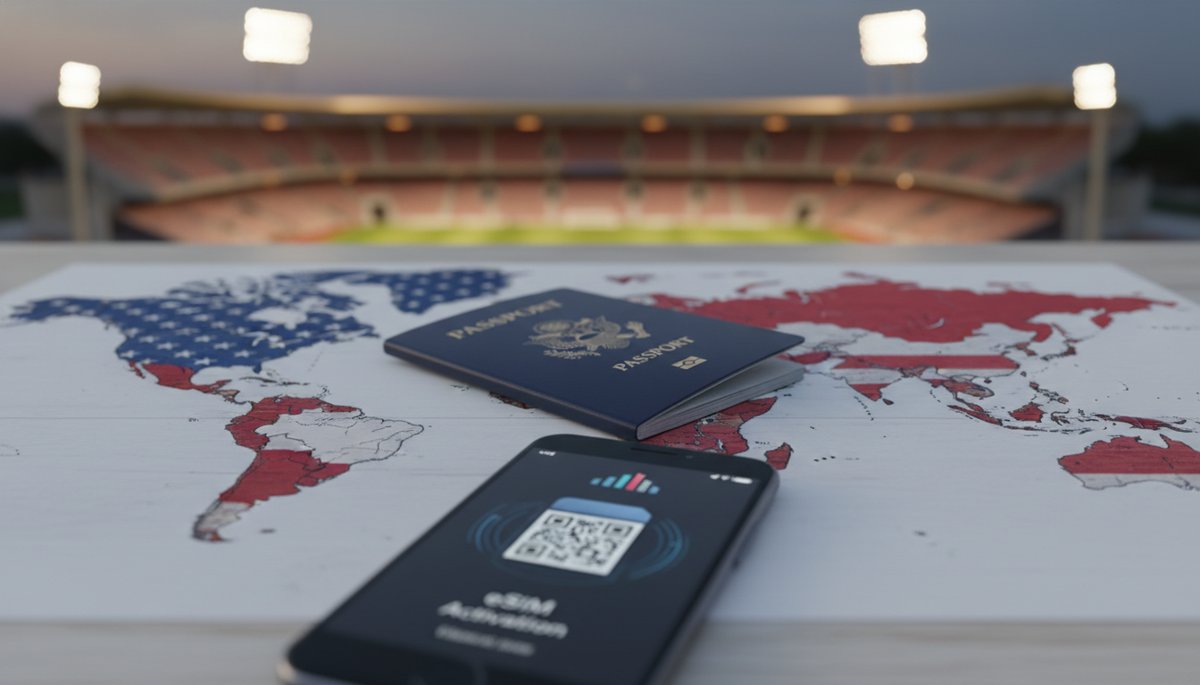
Quick Answer: The 2026 World Cup spans 16 cities in 3 countries from June 11 – July 19, 2026. Each border crossing requires its own travel authorization — ESTA ($40.27) for the US, eTA (CAD $7) for Canada, and an FMM tourist card (~$57 USD, included in airfare) for Mexico. None of these grants access to the others; apply separately for each country you plan to visit. A North America regional eSIM covers all three countries on one plan with no SIM swaps — the easiest connectivity solution for fans following a team across multiple host nations.
Disclosure: This post contains affiliate links. If you make a purchase through these links, we may earn a small commission at no extra cost to you. We only recommend products we genuinely believe in.
The 3-Country Landscape: Which Host Cities Are Where
Before you build any itinerary, map the geography. The 16 host cities split across three countries as follows (per FIFA's official host city list):
United States (11 cities): Atlanta, Boston, Dallas, Houston, Kansas City, Los Angeles, Miami, New York/New Jersey, Philadelphia, San Francisco Bay Area, Seattle
Mexico (3 cities): Guadalajara, Mexico City, Monterrey
Canada (2 cities): Toronto, Vancouver
The US hosts 78 of the 104 total matches, including all games from the quarterfinals onward. Mexico and Canada each host 13 matches. That means the deeper your team goes, the more likely you'll be spending time in the United States — but group stage routes can take fans through all three nations in the same week.
For the full breakdown of every city, venue, and connectivity setup, see our World Cup 2026 Travel Guide: Staying Connected Across All 16 Host Cities.
Border Crossings: What Actually Happens at Each Border
This is where most first-timers get tripped up. A World Cup ticket is not a travel document. Each country has its own immigration system, and your ticket gets you into the stadium — not through customs.
Entering the United States
Travelers from Visa Waiver Program countries (including most of Western Europe, Australia, Japan, South Korea) need an approved ESTA (Electronic System for Travel Authorization) before boarding. Apply at esta.cbp.dhs.gov. As of September 2025 the fee is $40.27 USD (up from $21) — it's valid for two years or until your passport expires. Apply at least 72 hours before travel — ideally weeks ahead given tournament volumes.
US Customs and Border Protection (CBP) has published specific guidance for World Cup 2026 fans on border preparation, recommending fans carry printed proof of match tickets and confirmed accommodation.
Entering Canada
Most visa-exempt travelers flying into Canada need an eTA (Electronic Travel Authorization). It costs CAD $7, is valid for five years, and takes minutes to process online — but apply before you book your flights. If you're crossing by land from the US into Canada (e.g., driving from Seattle to Vancouver), the eTA is not required, though you still need a valid passport.
Special eTA rule for some World Cup nations: Nationals of Argentina, Brazil, Mexico, Morocco, Panama, and Uruguay — who would normally need a full Canadian visitor visa — can apply for a Canadian eTA instead if they currently hold a valid US nonimmigrant visa or have held a Canadian visitor visa in the past 10 years. If neither condition applies, a full Canadian visitor visa from a consulate is required. Check your eligibility at ircc.canada.ca well before the tournament.
The Canada Border Services Agency (CBSA) has issued specific World Cup travel advisories recommending fans apply for travel authorizations well in advance of peak match days.
Entering Mexico
Nearly all foreign visitors entering Mexico need to complete a Forma Migratoria Múltiple (FMM) tourist card — regardless of nationality or length of stay. If you fly in, the fee (~$57 USD / 983 MXN for 2026) is bundled into your airline ticket as a tourism tax. If you enter by land for 7 days or fewer, the FMM is free, though you still need to process it at the INM office at the border. Citizens of roughly 65 countries (including the US, Canada, UK, EU, Japan, Australia) can enter Mexico visa-free for up to 180 days — the FMM is the entry permit, not a visa. Keep your stamped FMM with you throughout your stay in Mexico; immigration officials can request it at internal checkpoints.
The Key Rule for All Three Borders
Every crossing is treated as a separate immigration event. Plan your authorization timing, not just your flight timing. Build buffer time at each border — match day traffic will be heavier than typical.
Can You Cross the US-Canada and US-Mexico Borders by Land?
Yes — but with very different risk profiles.
US-Canada land crossings (Seattle–Vancouver via Peace Arch, Buffalo–Toronto via the Peace Bridge) are popular and safe. Expect 30–90 minutes of extra wait time on normal match days, with peak game days potentially doubling that. A valid passport is required — driver's licenses are not accepted at international crossings. NEXUS cardholders can use dedicated fast lanes to cut wait times significantly. Check live CBP wait times at cbp.gov/travel before heading to the border.
US-Mexico land crossings are a different calculation. Both the US State Department and most travel safety advisors recommend traveling between Mexican and US host cities by air due to criminal activity in certain border regions. If you are already in Mexico City, Guadalajara, or Monterrey, fly to your next US destination rather than driving north to the border. Direct flights between the Mexican host cities and US hubs (Dallas, Houston, Los Angeles) are plentiful and affordable when booked in advance.
The No-SIM-Swap Fix: One eSIM for All Three Countries
Here's the roaming math nobody does until they get the bill: without a cross-border plan, a few Google Maps sessions and WhatsApp calls in each country can easily stack into hundreds of dollars in carrier roaming fees across a five-week tournament.
The traditional workaround — buying a local SIM in each country — means three separate trips to phone stores, three plan activations, and losing access to your home number every time you swap. If you're moving from Monterrey to Dallas to Toronto in two weeks, that's a real logistical headache.
The cleaner solution is a North America regional eSIM. A single plan installed digitally before you leave home covers all three countries and auto-connects to local carrier networks at each border — no physical swap, no settings to change, no dead zone between countries.
Airalo's World Cup 2026 promotion is live through July 18, 2026: the North America Unlimited plan is 26% off. If you're staying for the full tournament, the Super Fan 40-day Unlimited plan is $99 USD flat.
Airalo's North America Unlimited eSIM (Affiliate link — I may earn a commission at no extra cost to you) covers the US, Canada, and Mexico on one plan. Plans range from 3 days up to 40 days of unlimited data — the 40-day plan is ideal if you're following a team from the group stage all the way to the July 19 final. It's data-only (no local number or SMS), so keep your regular SIM active in your phone's second slot for calls and texts from home.
A few practical notes:
- Your phone must be carrier-unlocked to use an eSIM from a third-party provider
- Install and test the eSIM before you leave home — not at the airport
- Set your regular carrier's data roaming to off once the eSIM is active to avoid accidental charges
For a full comparison of eSIM options for this tournament — including single-country plans for fans staying in one region — see our Best eSIM for the 2026 World Cup: USA, Mexico & Canada guide.
Getting Between Host Cities
The 16 host cities span roughly 4,375 kilometers (2,718 miles) from Vancouver to Miami. There is no single transport option that works everywhere — here's the honest breakdown:
Flights
Flights are the default for cross-border travel and any route over ~6 hours by road. Key advice:
- Book domestic US flights 6–8 weeks ahead; cross-border flights 8–12 weeks ahead
- Use a multi-city search on Google Flights to compare fly-in/fly-out combinations — saves backtracking
- Airports near host venues will be significantly busier than normal; budget extra time for security and ground transport
How the 2026 final week played out: the semifinals and Final were all in the US — Spain beat France in Dallas (July 14), Argentina beat England in Atlanta (July 15), and Spain beat Argentina 1–0 in the Final at MetLife Stadium (New York/New Jersey) on July 19 to win the World Cup. Because those cities are all in the United States, final-week travel meant no border crossing — just domestic flights (Dallas or Atlanta to New York, roughly 2.5–3.5 hours). It's a useful rule of thumb for any deep knockout run at a North American tournament: the further a team advances, the more the travel concentrates in one country.
Train (Where It Makes Sense)
Two routes where train genuinely beats flying:
- Seattle → Vancouver (Amtrak Cascades): Scenic, affordable, and far less stressful than a land border crossing in a rental car during tournament week
- Northeast Corridor (Amtrak): New York–Philadelphia–Boston is a natural multi-game corridor; trains run frequently and drop you near city centers
Road Trips
Works well for nearby US city pairs: Dallas–Houston (roughly 3.5–4 hours) and the San Francisco Bay Area–Los Angeles corridor (5–6 hours). Less practical for cross-border drives given expected volume at checkpoints.
Currencies and Payments: A Practical Cheat Sheet
Three countries means three currencies. Here's what actually matters in each:
| Country | Currency | Inside stadiums | On the street |
|---|---|---|---|
| USA | USD | Fully cashless | Cards everywhere; carry ~$40–60 for tips |
| Canada | CAD | Fully cashless | Cards everywhere; 1 USD ≈ 1.40 CAD |
| Mexico | MXN | Card + cash accepted | Carry cash for street food, markets; 1 USD ≈ 17–20 MXN |
Best practice: Use ATMs (not airport exchange counters) for local cash — airport exchange desks can charge 10–15% above real rates. Avoid "Dynamic Currency Conversion" prompts at card terminals in Canada and Mexico; always pay in local currency.
Time Zones: Building a Realistic Schedule
The 16 host cities span four time zones. If you're planning a multi-leg trip with matches in different regions, factor in the time difference when booking flights and reading match kick-off times.
| Time Zone | Host Cities |
|---|---|
| Pacific (UTC−7) | Vancouver, Seattle, Los Angeles, San Francisco Bay Area |
| Central (UTC−6) | Mexico City, Guadalajara, Monterrey, Houston, Dallas, Kansas City |
| Eastern (UTC−4/−5) | Toronto, Atlanta, Miami, Boston, Philadelphia, New York/New Jersey |
Toronto operates on Eastern Time; Vancouver on Pacific — a three-hour difference within Canada alone. Worth knowing if you're routing through both Canadian cities.
A Realistic Multi-Country Itinerary Template
If your team draws a typical group-stage route spanning Mexico and the US before knockout rounds, a workable structure might look like:
- Arrive Mexico City (group stage, Estadio Azteca) — apply FMM in advance
- Fly or bus to Guadalajara or Monterrey for a second group match — same country, no border
- Cross into the US (Dallas, Houston, or Kansas City for knockout rounds) — ESTA processed before travel
- Northeast or East Coast for quarterfinals onward — Amtrak works well in this corridor
- New York/New Jersey for the final — MetLife Stadium, July 19, 2026
This is illustrative — actual match routings depend on your team's results and FIFA's published schedule. Do not build rigid, non-refundable bookings around fixtures that haven't been played yet.
Pre-Trip Checklist for Multi-Country Fans
- [ ] Valid passport (6+ months beyond July 2026)
- [ ] ESTA approved (US) — apply at esta.cbp.dhs.gov, $40.27
- [ ] eTA approved (Canada, if flying in) — apply at ircc.canada.ca, CAD $7
- [ ] FMM ready (Mexico) — included in airfare; free at the border for land entry ≤7 days
- [ ] eSIM installed and tested before departure
- [ ] Flights booked multi-city to avoid backtracking
- [ ] Local currency plan: ATM or travel card, not airport exchange
- [ ] Match tickets saved offline — don't depend on connectivity at checkpoints
The Bottom Line
The 2026 World Cup's three-nation format is genuinely exciting — but it adds real logistical complexity that fans of previous tournaments haven't faced. The key moves are simple: get your travel authorizations sorted before you leave, plan transport by region rather than individual city hops, carry cards plus a small cash reserve for Mexico, and install a North America eSIM so your phone works the moment you land in each country.
For the deep dive on every host city — transport, neighborhoods, and connectivity specifics — the World Cup 2026 Travel Guide has the full picture.
Frequently Asked Questions
Do I need separate visas or travel authorizations for all three World Cup 2026 host countries?
Can I use one eSIM across the USA, Mexico, and Canada?
Is it safe to drive across the US-Mexico border for the World Cup?
Do land border crossings require a passport, or is a driver's license enough?
What currencies do I need for the 2026 World Cup?
You Might Also Like
Travel + Remote Work Briefing — October 13, 2026
Travel + Remote Work Briefing — October 12, 2026

Travel + Remote-Work Briefing — October 11, 2026