10 Travel Gadgets Every Digital Nomad Needs in 2026
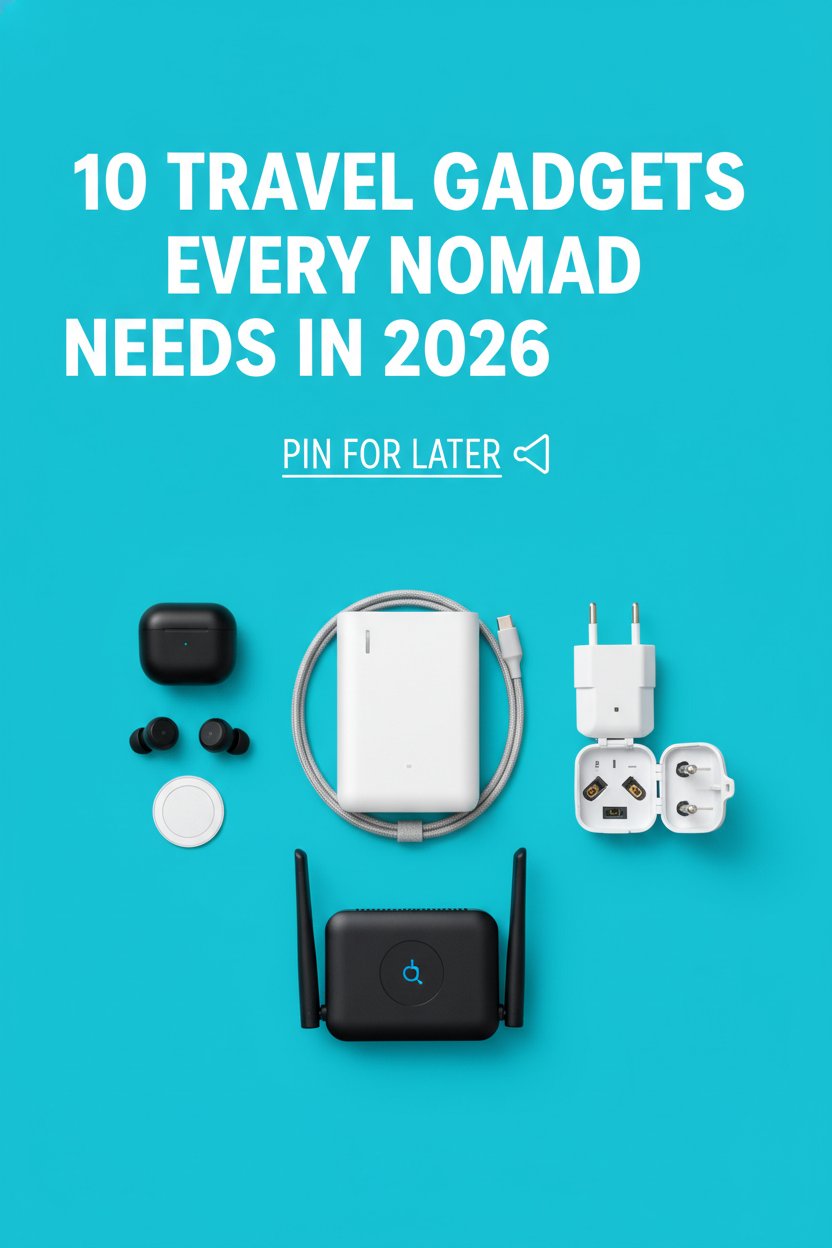
10 Travel Gadgets Every Digital Nomad Needs in 2026
Your laptop can go anywhere. The question is whether your gear can keep up.
Slow airport WiFi, a dead phone at hour seven of a layover, a bag that vanishes on the carousel in Bogotá — the wrong setup turns a dream work-from-anywhere life into a logistical nightmare. The right travel gadgets for digital nomads are the difference between a productive trip and a frustrating one.
This is a roundup of the 10 pieces of tech we consistently see recommended across nomad communities — real products, honest trade-offs, no fluff.
Disclosure: This post contains affiliate links. If you make a purchase through these links, we may earn a small commission at no extra cost to you. We only recommend products we genuinely believe in.
Quick Answer: The 10 must-have travel gadgets for digital nomads in 2026 are: a high-capacity power bank, a universal travel adapter, noise-cancelling earbuds, a Bluetooth tracker, a packable daypack, a travel router, an e-reader, a compact tripod, a portable SSD, and compression packing cubes. Each solves a specific pain point of location-independent work — covered in full below.
The 10 Best Travel Gadgets for Digital Nomads in 2026
Whether you're putting together your first digital nomad starter kit or auditing what's actually earning its weight in your pack, this list covers the essentials.
1. High-Capacity Portable Power Bank
The single most important piece of travel tech you can own.
A good power bank means you never have to sprint for an outlet at the gate, never have to ration screen time during a 10-hour bus ride, and never have to choose between charging your phone and your laptop.
For digital nomads, look for at least 20,000 mAh and USB-C Power Delivery (PD) at 65W or higher — that's enough to meaningfully charge most modern laptops, not just phones and tablets. Anker's PowerCore and Baseus' Blade series are the most consistently recommended options in nomad forums for their reliability and honest capacity ratings.
Trade-off: The bigger the capacity, the heavier it gets. Most airline carry-on rules cap you at 100Wh (around 27,000 mAh) — so check your specific bank before flying. Also, cheaper no-name options frequently inflate their mAh numbers; stick to established brands.
Anker PowerCore 26800 Power Bank — a well-reviewed 26,800mAh option with three high-speed USB-A ports. (If charging a laptop over USB-C matters most, look at Anker's USB-C Power Delivery models — see the buying tips above.)
2. Universal Travel Adapter with USB Ports
Plug shapes vary wildly across countries. This solves it in one device.
A universal travel adapter covers the four major outlet types (US, EU, UK, AU) and lets you use your devices anywhere without carrying a bag of individual adapters. The best ones include built-in USB-A and USB-C ports so you can charge multiple devices from a single wall outlet — useful in older hotels with limited sockets.
What to look for: Surge protection is important — voltage spikes in some countries (particularly in parts of Southeast Asia and Latin America) can damage sensitive electronics. A model with at least 2 USB-C ports plus the standard plug conversion is the sweet spot for most nomads.
Trade-off: Universal adapters are bulkier than single-country adapters. If you spend long stretches in one region, a slim region-specific adapter + a compact USB hub may be lighter.
TESSAN Universal Travel Adapter — a frequently recommended option with USB-C and USB-A ports and surge protection built in.
3. Noise-Cancelling Earbuds or Headphones
The single biggest productivity upgrade for cafe and co-working work.
Working in noisy environments is part of nomad life. Active noise cancellation (ANC) creates a quiet bubble wherever you are — crowded airports, loud hostels, busy cafes in Medellín. The difference between a focused work session and a fragmented one often comes down to whether you have good ANC.
The Sony WH-1000XM series (over-ear) and Bose QuietComfort line are the gold standards for ANC quality. For something more packable, the AirPods Pro and Sony WF-1000XM series (in-ear) are the most-loved among nomads who don't want bulk.
Trade-off: Over-ear headphones have better noise cancellation but are bulkier. In-ear ANC options are lighter but more fatiguing on long flights. Budget ANC earbuds exist, but the noise cancellation quality falls off sharply below a certain price point — it's one category where mid-range or better pays off.
Sony WH-1000XM5 Noise Cancelling Headphones — industry-leading ANC, up to 30 hours battery, foldable for travel.
4. Bluetooth Tracker (AirTag or Tile)
Cheap insurance against the worst travel stress: a lost bag.
Apple AirTags and Tile trackers are small, lightweight, and cost around $25-$35 each — a fraction of the cost of one delayed-bag claim or a lost laptop bag. Drop one in your checked luggage, one in your laptop bag, and you'll always know where your most important items are.
AirTags work best if you're in the Apple ecosystem (iPhone required for full functionality). Tile works across both iOS and Android and has a larger global network of trackers outside the US.
Trade-off: AirTags require iPhone for setup and offer the best accuracy via the Ultra Wideband chip on newer iPhones. Android users are better served by Tile or Samsung SmartTags. Neither system works perfectly in every country — coverage depends on how many other users are nearby.
Apple AirTag (4-Pack) — one for each bag plus a spare; works seamlessly with iPhone Find My.
Tile Pro Bluetooth Tracker — best cross-platform option for Android users.
5. Packable Daypack
Your go-to bag for day trips, co-working days, and airport runs.
A packable daypack lives in your main bag until you need it — then it unfolds into a full 20-30L backpack for a day trip, a beach run, or carrying your laptop to a co-working space. The best ones compress down to roughly the size of a water bottle and weigh almost nothing.
Brands like Matador, Osprey, and Patagonia make packable daypacks that are both durable and genuinely compact. Look for one with a padded laptop sleeve if you plan to work from it, and water resistance if you're traveling in tropical climates.
Trade-off: Ultra-light packable daypacks sacrifice structure — they won't protect a laptop as well as a rigid frame bag. If you carry your laptop in it regularly, prioritize one with a padded sleeve and some back panel structure.
Matador Freerain24 Packable Daypack — 24L, rolls into its own pocket, waterproof, has a laptop sleeve.
6. Travel Router
Turn sketchy hotel WiFi into a private, faster connection.
Hotel and hostel WiFi is often firewalled, throttled, or requires a separate login for each device. A travel router solves this: you connect it to the hotel network once, and it broadcasts its own private WiFi signal that all your devices share. Many travel routers also support WireGuard or OpenVPN built-in — handy when you need a VPN connection on every device without configuring each one separately.
The GL.iNet family (GL-MT300N-V2, GL-AXT1800) is the most popular choice among nomads for their small size, solid open-source firmware, and good value. If you work with sensitive data or do client work, a travel router with VPN support is close to essential — especially when working remotely from Southeast Asia, where public WiFi is widespread but not always trustworthy.
Trade-off: Travel routers add a small device to your kit. Setup takes 10-15 minutes the first time but is straightforward. They don't fix underlying slow connections — they just share and secure them.
GL.iNet GL-MT3000 Travel Router — compact, dual-band WiFi 6, built-in VPN client support.
7. E-Reader
A library in your bag that weighs less than a paperback.
If you read at all — whether for research, learning, or downtime — an e-reader is one of the best quality-of-life upgrades in a nomad's kit. A Kindle Paperwhite holds thousands of books, has weeks of battery life, is waterproof, and is easy on the eyes in any lighting. It weighs around 200 grams.
For nomads who also do professional development on the road, Kindle Unlimited gives access to a large library for a flat monthly fee. Combining that with AI tools that help budget travelers plan smarter is a solid way to keep learning without adding weight.
Trade-off: An e-reader is a single-purpose device. If you already carry a tablet and read on it regularly, you may not need both. But if you find yourself squinting at phone screens during flights or killing your phone battery with books, the dedicated e-reader earns its place quickly.
Kindle Paperwhite (16GB) — waterproof, 3-month battery life, adjustable warm light, excellent for travel.
8. Compact Tripod or Flexible Gorilla Tripod
For video calls, content creation, and not asking strangers for photos.
A compact tripod serves multiple purposes for nomads: stable video calls without holding your phone, content creation for social media or client work, and hands-free photography. The Joby GorillaPod is the go-to for flexibility — its bendable legs can clamp around poles, railings, or tree branches for shots you couldn't get any other way.
For video calls specifically, getting your camera at eye level (instead of looking up from a desk) immediately makes you look more professional on client calls. A tripod with a phone mount solves this even when you're using a laptop webcam, by positioning a secondary phone camera at the right height.
Trade-off: A full-size travel tripod (like the Peak Design Travel Tripod) is excellent but expensive and still adds weight. For most nomads, a Gorilla-style flexible mini tripod is the better starter option — versatile, light, and under $40.
Joby GorillaPod 3K Flexible Tripod — handles cameras up to 3kg, fits in a jacket pocket, works as a phone stand for video calls.
9. Portable SSD
Offline backup and fast file transfer, anywhere in the world.
Cloud storage is great — until you're in a guesthouse in rural Vietnam with 2Mbps WiFi trying to access a 4GB client deliverable. A portable SSD (solid-state drive) stores your most important files locally, transfers data fast, and is durable enough to survive life in a backpack.
The Samsung T7 and WD My Passport SSD are the most commonly recommended options. They're small enough to fit in a jeans pocket, transfer at speeds that make large file work practical, and survive the bumps of travel far better than spinning hard drives.
For nomads doing video work, photo editing, or regular client file transfers, a portable SSD isn't optional — it's critical infrastructure. See our Everything Backpack review for digital nomads for more on how to organize your full gear setup.
Trade-off: Portable SSDs are more expensive per gigabyte than external HDDs. But they're dramatically faster, lighter, and more shock-resistant — worth the premium for most nomads.
Samsung T7 Portable SSD (1TB) — USB-C, fast transfer speeds, slim enough to forget it's in your bag.
10. Compression Packing Cubes
Not just organization — actually pack more in less space.
Compression packing cubes have a double-zip system: one to organize, one to compress. The result is that you can fit roughly 30% more into the same bag compared to loose packing, and you can find anything instantly without unpacking everything.
Eagle Creek and Peak Design make the most durable options. For budget-conscious travelers, Amazon Basics compression cubes are a solid entry point that won't break the bank.
The practical benefit for nomads: faster airport security (pull out the electronics cube, done), easier bag transitions between accommodation types, and the ability to live out of a carry-on indefinitely — which is the holy grail of nomad travel.
Trade-off: You need to actually use the system consistently or they become expensive laundry bags. A set of 3-4 cubes (small, medium, large) handles most load-outs. If you're already a organized packer, the compression benefit is the main upgrade here.
Eagle Creek Pack-It Reveal Compression Cube Set — lifetime guarantee, excellent compression ratio, available in multiple sizes.
How to Prioritize These Gadgets on a Budget
You don't need all 10 at once. Here's how to think about it:
Start here (under $150 total):
Universal travel adapter (~$25-$35)
Compression packing cubes (~$30-$40 for a set)
Bluetooth tracker (~$25-$35 each)
Add next (biggest productivity impact):
Power bank with laptop PD charging (~$50-$80)
Noise-cancelling earbuds (budget: ~$50; mid-range: ~$150-$200)
When you're ready to invest:
Travel router (~$60-$100)
Portable SSD (~$80-$120 for 1TB)
E-reader (~$100-$140)
The tripod and packable daypack can go either way depending on how much you shoot content or do day trips.
The Gadgets That Didn't Make the Cut
A few items come up in every "best nomad gear" list that we deliberately left out:
Portable monitor: Useful for developers, but adds significant weight and bulk. Most nomads drop it after one trip.
Smart luggage: The locks and GPS trackers built into smart bags are convenient, but most airlines now restrict or ban integrated lithium batteries in checked luggage. More hassle than it's worth.
Portable projector: A fun idea that almost never gets used. Leave it.
Final Thoughts
The best travel gadgets for digital nomads aren't about having the most gear — they're about having the right gear that solves real problems you'll actually face on the road. A power bank that can charge your laptop, a travel router that secures your connection, and noise-cancelling earbuds that let you focus are worth infinitely more than a bag full of gadgets you never reach for.
Start lean, identify your actual friction points after your first month on the road, and build from there. The nomad life is about freedom — and freedom doesn't mean carrying everything.
If you're still figuring out the remote income side of things, browse the remote work opportunities on job4travelers.com — because the best travel gear in the world is useless without income to fund the trips.
Frequently Asked Questions
What is the most important travel gadget for digital nomads?
Do I really need a travel router as a digital nomad?
Are Bluetooth trackers worth it for travelers?
What should I look for in a travel power bank for laptops?
What travel gadgets are best for working in noisy cafes or co-working spaces?
You Might Also Like
Travel + Remote-Work Briefing — October 25, 2026

Travel + Remote Work Briefing — October 24, 2026

Travel + Remote Work Briefing — October 22, 2026