Berlin Marathon 2026: Complete Spectator Guide
Every autumn, one Sunday in Berlin turns into the loudest street party in the city's calendar — and most of the noise is for strangers running past at a 3-minute-per-kilometer pace. The BMW Berlin-Marathon is one of the six Abbott World Marathon Majors, and it's arguably the one where spectating is easiest: the course loops through the city center and finishes at a landmark you'll want photos of anyway.
Quick Answer: The BMW Berlin-Marathon 2026 runs Sunday, 27 September 2026, starting and finishing near the Brandenburg Gate. Watching is free from anywhere along the route — no ticket needed — and the best atmosphere is at the start/finish, Kurfürstendamm, Potsdamer Platz, and Wilder Eber. Race weekend also includes an inline-skating marathon and a shakeout breakfast run on the Saturday, so plan to arrive by Thursday if you want the full experience.
This guide covers the schedule, why Berlin keeps producing some of the fastest marathon times in history, where to stand, and how to actually move around a city that closes half its center for a morning.
When is the Berlin Marathon 2026?
The BMW Berlin-Marathon 2026 takes place on Sunday, 27 September 2026. The main field starts in waves from around 8:45 a.m., with wheelchair and handbike athletes starting slightly earlier from roughly 8:20 a.m.
Race weekend, not just race day, is the bigger picture. The official Marathon Expo at the former Tempelhof Airport opens Thursday, 24 September and runs through Saturday, 26 September, and Saturday itself is packed with the inline-skating marathon, the mini-marathon, and the kids' Bambini Run before Sunday's main event.
Why is Berlin the fastest marathon course?
Berlin has roughly 40 meters of total elevation change across the entire 42.195 km course — close to flat by marathon standards — combined with wide, straight boulevards and mild late-September weather. That combination is why the men's marathon world record was set or broken in Berlin nine times between 2003 and 2022, and why Tigist Assefa's 2:11:53 women's world record also came from this course in 2023.
Those specific records have since moved elsewhere — Sabastian Sawe ran the first sub-two-hour marathon in an official race, 1:59:30, at the 2026 London Marathon — but Berlin's course design hasn't changed. It's still the layout coaches point to when they talk about "fast" marathon courses, and it's a big part of why elite fields keep coming back.
Where is the best place to watch the Berlin Marathon?
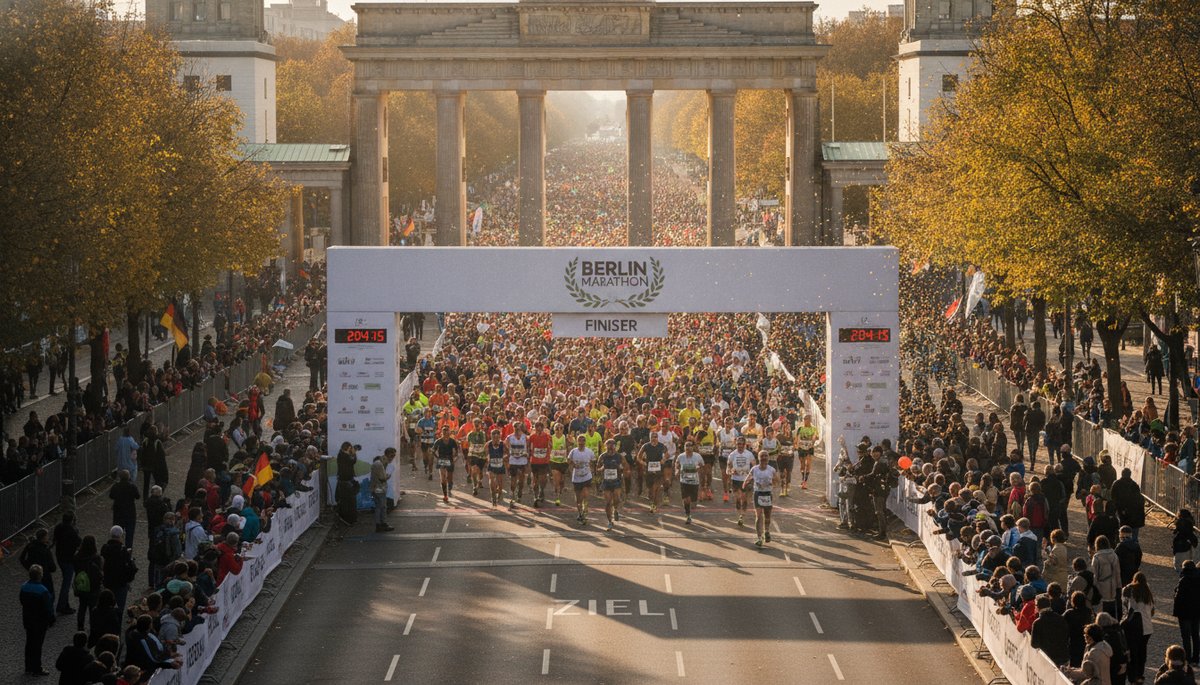
The start and finish area on Straße des 17. Juni, right at the Brandenburg Gate, has the biggest atmosphere and the payoff shot of runners coming through the Gate itself. If you can only pick one spot, pick this one — you'll see both the start and, a few hours later, the finish.
Beyond the Gate, spectators commonly stake out Kurfürstendamm around the 14 km mark (Berlin's famous shopping boulevard, always packed with cheering crowds), Potsdamer Platz around 25 km (central, easy transit access, plenty of cafés to wait in), and Wilder Eber around 28 km, which has a reputation among regulars as one of the loudest points on the course. Realistically, pick two or three spots rather than trying to chase runners across the whole route on foot — the marathon moves faster than you'd think, and the U-Bahn only helps if you're not fighting road closures to reach the platform.
Do you need a ticket to watch the Berlin Marathon?
No — spectating the Berlin Marathon is free everywhere along the public route. You don't need a ticket, wristband, or registration to stand on the sidewalk and cheer; the only cost is your own transport and time.
The one thing worth planning ahead for is proximity: the most popular spots (Brandenburg Gate, Kurfürstendamm) fill in early, so if you want a front-row view rather than a view over someone's shoulder, arrive at least 45–60 minutes before the runners you're tracking are due to pass.
How do you enter the Berlin Marathon?
Most runners get in through the annual lottery, which for the 2026 race opened its registration window from 25 September to 6 November 2025 — meaning if you're reading this ahead of the 2026 race, that lottery has already closed. Guaranteed-entry routes exist year-round through official charity partners and tour operators, and there's a separate guaranteed pathway for wheelchair and handbike athletes.
If the lottery timing doesn't work for a future year, charity or travel-package entry is the more reliable route, and it's worth checking the official registration page directly, since fees and the field-size cap change year to year. The entry fee for 2026 was listed at €205, covering the finisher medal, transport pass, and expo access, with a 6-hour-15-minute course time limit.
How do you get around Berlin on marathon day?
Skip driving anywhere near the center — large sections of Berlin close to vehicle traffic for the marathon, and the official guidance is blunt about it: use public transportation. The U-Bahn and S-Bahn keep running (with some route adjustments), and the city takes this seriously enough that runners' bib numbers double as a valid transit ticket across fare zones A, B, and C from the Thursday before the race through race day itself.
Key stations near the start/finish area include Brandenburger Tor, Unter den Linden, Bundestag, and Potsdamer Platz — all on lines that stay in service, though expect crowding and occasional detours around the closure zone. If you're meeting a runner after the race or tracking their progress on the official app between spectating spots, having reliable mobile data matters more than usual on a day when the city's normal traffic patterns are scrambled. An Airalo Germany eSIM installs before you land and keeps maps, the BVG transit app, and the runner-tracking app working without hunting for a SIM shop the morning of the race. (Disclosure: this is an affiliate link — job4travelers may earn a commission at no extra cost to you if you buy through it.)
What happens on Berlin Marathon weekend before race day?
Race weekend actually starts on the Saturday, when Berlin's marathon course briefly belongs to a completely different crowd. The Saturday before the marathon (26 September 2026) hosts the inline-skating marathon, with skaters starting from around 12:20 p.m. and racing the full course before runners take it over the next morning.
The same Saturday traditionally includes the Generali Breakfast Run — a relaxed, non-competitive shakeout jog that's become part of the pre-race tradition, typically starting around 9:30 a.m. and covering about 6 km from Charlottenburg Palace to the Olympic Stadium, finishing with a lap of the stadium track. It's popular with runners loosening up their legs the day before 42.195 km, and plenty of spectators-in-training join just for the atmosphere and the free pastries at the finish. Saturday also brings the mini-marathon (a 4.2195 km school-age event around midday) and the Bambini Run for younger kids at Tempelhof — so if you're in Berlin a day early, there's plenty to watch before the main event.
Where do you pick up your race bib?
Bib pickup happens at the Marathon Expo at the former Tempelhof Airport, open from Thursday through Saturday of race week. You'll need your Start Card and a photo ID, and pickup is in person only — no picking up for a friend, even with their documents.
The expo itself is worth a visit even if you're only spectating — it's a large sports-gear and running expo inside a genuinely striking piece of Berlin architecture, and it's an easy way to soak up race-weekend energy before the Sunday closures start.
What else to do in Berlin that weekend
Marathon weekend is a good excuse to build a longer Berlin trip around it rather than flying in and out for one Sunday morning. The city's museums, the Reichstag dome, and the East Side Gallery are all easy add-ons within transit range of the marathon route, and late September weather in Berlin tends to be mild enough for a lot of walking. Berlin also runs a busy calendar of festivals through the year — if you're curious what else draws crowds to the city, our guide to Berlin's summer festival calendar covers the bigger annual events beyond the marathon.
If race weekend turns into a longer stay — some travelers extend a marathon trip into a few weeks of remote work from Berlin — it's worth understanding EU entry rules under EES before you book, since the EU's new entry/exit system changes how short stays are tracked at the border. And whether you're flying in just for the race or staying longer, finding cheap flights to Berlin well ahead of a Major marathon weekend is worth doing early — fares and hotel rates both climb as the date approaches, since this is one of the busiest travel weekends Berlin has all year.
Packing for a marathon weekend in Berlin
Late September in Berlin runs cool and can turn wet without much warning, which matters whether you're running or standing on a sidewalk for four hours cheering. Layers, a packable rain shell, and comfortable walking shoes matter more than race-day gear if you're spectating — you'll cover more distance chasing viewing spots than you'd expect. If you're combining the trip with remote work before or after the race, our digital nomad packing checklist covers the gear worth bringing so you're not scrambling for an adapter or a laptop stand the morning after 26.2 miles of celebrating other people's finish times.
Whether you're running it, tracking a friend through six different neighborhoods, or just picking a café near Potsdamer Platz to watch the world's fastest amateurs go by, the Berlin Marathon is one of the more spectator-friendly Majors on the calendar. Book the flight, plan two or three viewing spots instead of trying to see it all, and leave the car at the hotel.
Frequently Asked Questions
When is the Berlin Marathon 2026?
Where is the best place to watch the Berlin Marathon?
Why is Berlin the fastest marathon course?
How do you get around Berlin on marathon day?
Do you need a ticket to watch the Berlin Marathon?
You Might Also Like
Travel + Remote Work Briefing — October 12, 2026
Travel + Remote-Work Briefing — October 11, 2026

Travel + Remote-Work Briefing — October 10, 2026