
The Azores in 2026: Portugal's Hidden-Gem Archipelago for Travelers
The Azores in 2026: Portugal's Hidden-Gem Archipelago for Travelers
Nine volcanic islands rising from the mid-Atlantic, halfway between Lisbon and New York — the Azores have long attracted travelers who prefer dramatic landscapes over crowded beach resorts. In 2026, there is an extra reason to go: the archipelago is celebrating 50 years of regional autonomy, and the festival calendar this summer is unlike any year in recent memory.
This Azores 2026 travel guide covers when to go, which island to start on, how to get there from the US, island-hopping logistics, and why this corner of Portugal works surprisingly well as a remote-work base.
Quick Answer: The Azores in 2026 is a standout destination for travelers who want volcanic scenery, whale watching, and genuine Portuguese festival culture without mainland crowds. São Miguel is the best entry point. Nonstop flights run from Boston year-round on both Azores Airlines and TAP. The summer festival calendar — anchored by Semana do Mar (July 31–Aug 9, Faial) and the Sanjoaninas (June 19–28, Terceira) — carries extra weight thanks to the 50th anniversary of autonomy.
Disclosure: This post contains affiliate links. If you make a purchase through these links, we may earn a small commission at no extra cost to you. We only recommend products we genuinely believe in.
Is the Azores Worth Visiting in 2026?
Yes — and the timing is genuine, not marketing. The Autonomous Region of the Azores marks the 50th anniversary of its Constitutional Autonomy in 2026, with a year-long program of official ceremonies, cultural festivals, and concerts across all nine islands.
The Sanjoaninas festival in Angra do Heroísmo (Terceira), running June 19–28, has been confirmed as the central stage for the autonomy anniversary. It combines traditional rope bullfights, Marchas parades, and folk performances with anniversary-specific programming — making this edition one of the most significant in the festival's history.
Beyond the milestone, the Azores' core appeal stands on its own: vivid crater lakes, geothermal hot springs you can actually eat from, whale watching in some of the richest cetacean waters in Europe, and a pace of life that makes you recalibrate quickly.
What Is the Best Time to Visit the Azores?
May through September is the main travel window. Within that span:
May–June (shoulder): fewer visitors, lower prices, wildflowers on the hillsides, and the Sanjoaninas to close out June.
July–August (peak): warmest temperatures, all the major festivals, and the best conditions for whale watching off Pico. Book inter-island flights and accommodation well ahead — the 50th anniversary is drawing additional visitors, and some routes were already near capacity in summer 2025.
September (shoulder): crowds thin, prices ease, and the Atlantic is at its warmest for swimming.
Atlantic weather changes fast at any time of year. Pack for fog and rain even in July. Brief showers are common; volcanic highlands often sit in cloud while the coast stays sunny. A waterproof layer is not optional.
Which Azores Island Should I Visit First?
São Miguel is the sensible starting point. As the largest island, it has the main international airport (João Paulo II, PDL), the highest frequency of inter-island connections, and two flagship attractions.
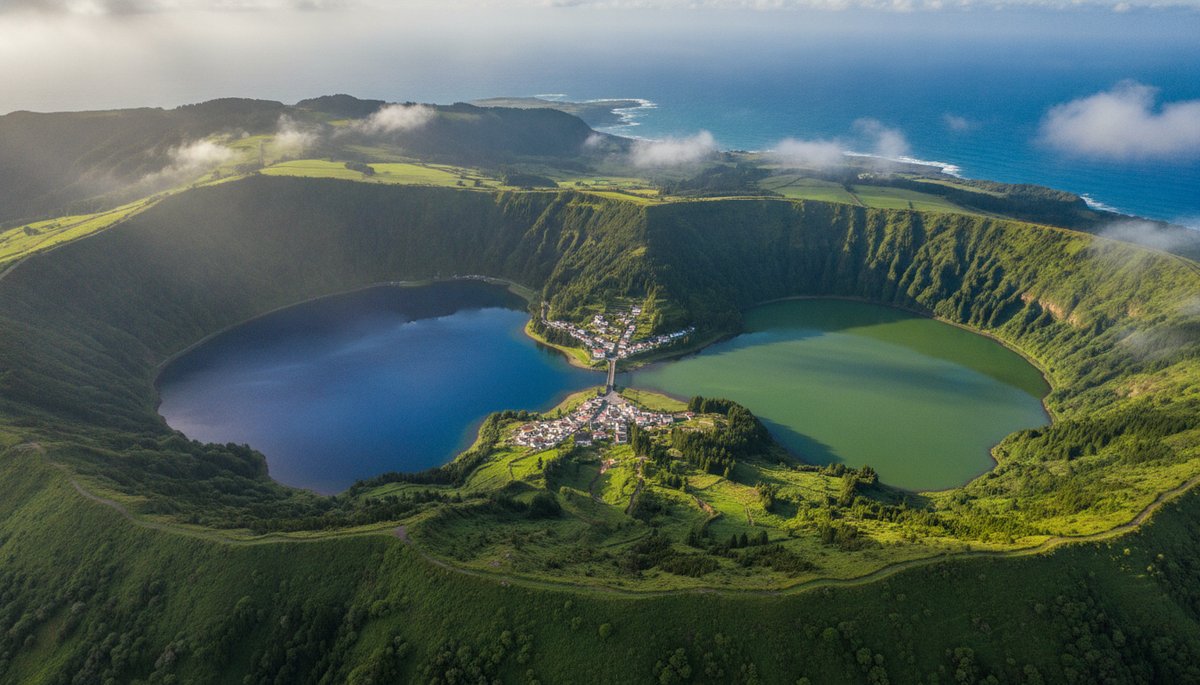
Sete Cidades is a collapsed volcanic caldera on the island's western tip, holding twin lakes — one blue, one green — inside a crater rim. The Vista do Rei viewpoint is the classic angle; a multi-hour rim trail is the deeper one.
Furnas is a geothermal valley in the east where steam vents and bubbling mud pools surround a lake. The village is famous for cozido das Furnas — a meat and vegetable stew slow-cooked underground using geothermal heat.
Faial and Pico are the logical next pair. Faial's Horta marina is a legendary waypoint for transatlantic sailors; across a 30-minute ferry ride, Pico island is home to Portugal's highest peak (Mount Pico) and the best whale-watching operations in the archipelago.
Terceira rounds out a classic three-island circuit, centered on the UNESCO-listed city of Angra do Heroísmo and the Sanjoaninas festival.
How Do You Get to the Azores from the US?
Azores Airlines and TAP Air Portugal both operate nonstop flights between Boston Logan (BOS) and Ponta Delgada (PDL). Azores Airlines' 2026 summer schedule runs around 11 weekly nonstop flights on this route; TAP runs around 10. Flight time is approximately 6 hours. Seasonal nonstop service also operates from the UK and Toronto.
Book your inter-island connections — SATA Air Açores flights or Atlânticoline ferries — at the same time as your transatlantic ticket, not as an afterthought. If you're flying through Europe, be aware of recent summer disruption patterns — our guide on Europe summer flight disruptions and your passenger rights is worth reading before you go.
For connectivity from the moment you land: the Airalo Portugal eSIM covers the whole country including the Azores — activate once, use across every island without swapping physical SIMs. (Affiliate link — we may earn a commission at no extra cost to you.)
Azores Island-Hopping in 2026
SATA Air Açores operates around 572 weekly inter-island flights across 16 routes in its 2026 summer schedule. Flight times run from around 20 minutes (Pico–Faial) to about an hour (São Miguel–Flores). One-way inter-island fares generally fall in the €60–€120 range, depending on route and booking lead time.
Ferries (Atlânticoline) connect the central island group — Faial, Pico, São Jorge, Graciosa, and Terceira — as a scenic, affordable daytime alternative. Inter-group ferry connections (linking the eastern, central, and western groups) have not operated since 2022; for those longer hops, flying is the only option.
A practical three-island circuit: fly into PDL, spend 3–4 days on São Miguel, fly to Faial, take the ferry across to Pico, then fly back to PDL for your transatlantic connection.
2026 Azores Festivals: What to Plan Around
Festival | Dates | Island | Highlight |
|---|---|---|---|
Sanjoaninas | June 19–28 | Terceira | 50th autonomy anniversary; rope bullfights, Marchas parades |
North Wave Sound | July 25 | São Miguel (Ribeira Grande) | All-female lineup; ~7,000 attendees; €18 GA |
Semana do Mar | July 31–Aug 9 | Faial (Horta) | 49th edition; Portugal's largest nautical festival |
Maré de Agosto | August | Santa Maria | Maritime summer festival on the sunniest island |
Festival weekends on small islands with limited accommodation sell out fast. Lock in lodging as soon as dates are confirmed, particularly for Horta during Semana do Mar.
Can You Work Remotely from the Azores?
The Azores is a viable remote-work base — quieter and less expensive than Lisbon, and easier on US time zones than most of Europe.
EU/Schengen territory. No permit complications for EU/EEA citizens. Non-EU nationals planning stays over 90 days should review Portugal's digital nomad visa — our digital nomad visa countries in 2026 guide covers the options.
Internet. Fiber with speeds up to 200 Mbps is available in town centres across the major islands. Ponta Delgada has the densest coverage; Vodafone and MEO are the main carriers.
Time zone advantage. The Azores runs on UTC-1 in summer — one hour behind the UK and mainland Portugal, and much closer to US East Coast business hours than most of Europe. Morning syncs are workable.
Coverage gaps. Rural areas, coastal trails, and the interiors of smaller islands have spottier 4G/LTE. Base yourself in a main town for reliable work sessions, and explore the backcountry on off-days.
For a long-stay cost and lifestyle comparison alongside other European destinations, see our post on shoulder-season travel in Europe for remote workers.
The Azores in 2026 is not a flashy destination. There are no theme parks or all-inclusive strips. What it offers is volcanic geology that is still actively shaping the land, some of the highest cetacean diversity in the North Atlantic, traditional festivals that predate mass tourism, and a scale — nine islands, none of them enormous — that keeps everything navigable. If that is the trip you are looking for, the 50th anniversary makes 2026 a better year to go than most.
Frequently Asked Questions
Is the Azores worth visiting in 2026?
What is the best time to visit the Azores?
Which Azores island should I visit first?
How do you get to the Azores from the US?
Can you work remotely from the Azores?
You Might Also Like

Travel + Remote Work Briefing — October 22, 2026
Travel + Remote Work Briefing — October 21, 2026

Travel + Remote Work Briefing — October 20, 2026