
Gibraltar's Open Border Reshapes Nomad Options on the Costa del Sol
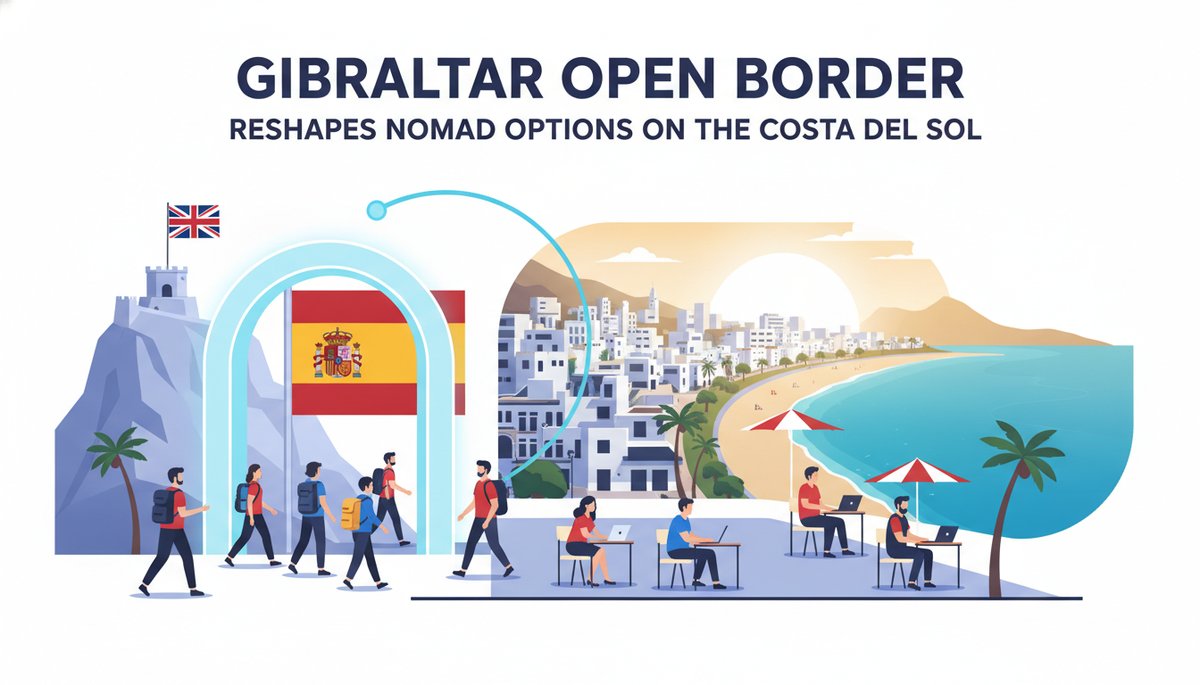
A post-Brexit deal between the UK, EU, and Spain removes 118 years of physical border controls between Gibraltar and Spain, with provisional implementation set for July 15, 2026. The arrangement dismantles the land barrier separating Gibraltar from the Andalusian town of La Línea de la Concepción and lifts checks on the roughly 15,000 workers who cross the frontier daily, the majority of whom are Spanish.
The border fence has stood since 1908. Under the new treaty, published in February 2026, goods and people can move freely across the land crossing without stopping for passport stamps or vehicle checks.
What the deal actually does — and doesn't do
The agreement does not make Gibraltar a Schengen member. Instead, according to the UK Government's announcement, Spanish authorities will carry out Schengen-area checks on behalf of the EU at Gibraltar's airport and port — a model similar to French police operating at London's St Pancras station. Immigration, policing, and justice inside Gibraltar remain the sole responsibility of Gibraltar's own authorities.
Full parliamentary ratification by both the UK and European Parliaments is still pending. The July 15 date reflects provisional implementation, not final treaty entry into force.
The economic asymmetry around the crossing is striking. La Línea carries unemployment of near 30 percent, according to reporting by BBC News, and local businesses derive roughly one-third of their income from Gibraltar clients. The frictionless land border accelerates that economic integration. Gibraltar, meanwhile, is introducing a transaction tax starting at 15 percent — replacing existing import duties — with the rate set to rise to 17 percent under the treaty's three-year convergence schedule.
What this means for remote workers and nomads
The clearest benefit is for nomads already basing themselves on the Costa del Sol. The land crossing between Gibraltar and La Línea is now effectively a walk-through, removing the 20-to-45-minute queues that previously made the crossing a planning decision rather than a casual one.
That matters because the cost arbitrage between the two sides of the fence is substantial. According to Numbeo's current comparison, the overall cost of living in Gibraltar runs more than 91 percent higher than in La Línea, and rent in Gibraltar is roughly 200 percent higher. Living in La Línea while working or networking in Gibraltar — which has an established fintech and digital sector, fast fiber connectivity, and no VAT — becomes a more practical arrangement when the crossing no longer costs you an hour.
For non-EU nomads, however, important caveats apply. Gibraltar's integration into a Schengen-style border arrangement means crossings will be tracked digitally under the EU Entry/Exit System. Idealista's legal analysis of the deal warns that travelers spending extended periods in Spain without formal residency may find informal "border runs" harder to sustain once digital tracking is fully operational. The Schengen 90-in-180-days rule still applies to non-EU, non-resident visitors — Gibraltar does not reset the clock. If you are planning a longer stay in southern Spain, legal residency rather than border-hopping remains the sustainable path.
For nomads already holding a Spanish residence permit or a longer-stay visa, the removal of land border controls is an unambiguous quality-of-life gain: English-speaking infrastructure, zero-VAT shopping, and Gibraltar's professional community are now a short walk from far cheaper Andalusian rentals.
Sources
New era for Gibraltar with removal of 118-year-old border controls with Spain — Yahoo News / BBC, accessed July 13, 2026
Agreement protects sovereignty and economic security of Gibraltar — UK Government, accessed July 13, 2026
Cost of Living Comparison: La Linea de la Concepcion vs Gibraltar — Numbeo, accessed July 13, 2026
Gibraltar's new border deal: what it means for Spain, the UK, and British residents in Spain — Idealista, accessed July 13, 2026
You Might Also Like

Travel + Remote Work Briefing — October 15, 2026

Travel + Remote Work Briefing — October 14, 2026

Travel + Remote Work Briefing — October 13, 2026