Houston World Cup 2026: Stadium, Transit & Travel Guide
Houston World Cup 2026: Stadium, Transit & Travel Guide
Houston is one of the most distinctive World Cup 2026 host cities — a sprawling, humid, endlessly multicultural Texas metropolis with one singular advantage that no other venue can match: the only air-conditioned stadium in the entire tournament. If you're planning a trip to watch matches here, this guide gives you everything you need before you land: the stadium, the transit plan, where to stay, what to see, and how to keep your phone connected without hemorrhaging money on roaming fees.
Quick Answer: Houston hosts seven 2026 World Cup matches at NRG Stadium — officially renamed Houston Stadium for the tournament. The venue seats 68,311 in soccer configuration and is the only World Cup venue with a retractable roof and full air conditioning (72°F/22°C inside). The METRORail Red Line runs directly to Stadium Park/Astrodome Station, 15–20 minutes from downtown, at $1.25 one-way. Best neighborhoods to stay: Midtown (on the Red Line, buzzy nightlife), Museum District (calmer, also Red Line), EaDo (near the Fan Festival), and Downtown (transit hub, fan zones).
Disclosure: This post contains affiliate links. If you make a purchase through these links, we may earn a small commission at no extra cost to you. We only recommend products we genuinely believe in.
Which Stadium Hosts the 2026 World Cup in Houston?
The venue is NRG Stadium — officially renamed Houston Stadium for the duration of the FIFA tournament, in line with FIFA's policy on corporate-sponsored naming rights. The stadium sits roughly 3 miles south of downtown Houston, right next to the Astrodome.
In its World Cup soccer configuration, Houston Stadium holds 68,311 spectators. The stadium's normal NFL capacity is 72,220 (home of the Houston Texans), but FIFA reconfigures seating and media zones to the tournament standard. Natural grass has been installed in place of the Texans' artificial turf — FIFA mandates grass surfaces, and the climate-controlled building makes that technically possible year-round.
The defining feature for World Cup visitors: this is the only 2026 World Cup stadium with a fully retractable roof and air conditioning. Interior temperature during matches is maintained at approximately 72°F (22°C). Given Houston's June–July heat index routinely topping 105°F outside, that detail matters more here than almost anywhere else in the tournament.
Houston draws seven matches total:
| Date | Match | Round |
|---|---|---|
| June 14 | Germany vs. Curaçao | Group Stage (Group E) |
| June 17 | Portugal vs. DR Congo | Group Stage (Group K) |
| June 20 | Netherlands vs. Sweden | Group Stage |
| June 23 | Portugal vs. Uzbekistan | Group Stage (Group K) |
| June 26 | Cape Verde vs. Saudi Arabia | Group Stage (Group H) |
| June 29 | Brazil vs. Japan | Round of 32 |
| July 4 | TBD | Round of 16 |
The July 4 Round of 16 is one of the tournament's marquee scheduling decisions — Independence Day, in one of America's biggest cities, with a high-stakes knockout game in an air-conditioned stadium. Book accommodation well before that date.
How to Get to Houston Stadium: Take the Red Line
Driving to NRG Stadium on match day is strongly discouraged. Houston freeway congestion is already intense on a normal weekend; add 68,000+ fans and stadium parking fees that can exceed $100–$175 per car on World Cup days. The right answer is METRORail.
How to Get to NRG Stadium by METRORail
The METRORail Red Line runs directly to Stadium Park/Astrodome Station, which is a short walk from the stadium gates. This is the cleanest, fastest, and cheapest way to get there.
Key details for match day:
- Travel time from downtown: ~15–20 minutes from Main Street Square Station or Theater District Station
- Fare: $1.25 one-way — tap a credit card, debit card, Apple Pay, Google Pay, or use the RideMETRO app. No cash required.
- Frequency on match days: every 6 minutes (METRO significantly expands train capacity and frequency for World Cup events)
- Transfer point: If you're coming from areas outside the Red Line, transfer at Central Station (downtown) to reach the stadium
METRO's official World Cup transit hub is at ridemetro.org/world-cup — check it before match day for any schedule updates.
From IAH (George Bush Intercontinental Airport)
IAH is ~27 miles from NRG Stadium — about 35–45 minutes by rideshare ($40–$50), or 90 minutes+ by public transit (METRO bus connecting to the Red Line). For most international arrivals, a rideshare directly to your hotel on arrival day, then using METRORail on match day, is the practical approach.
From HOU (William P. Hobby Airport)
Hobby Airport is ~11 miles from the stadium — a 20–30 minute drive. It's also closer to the Red Line: take METRO Bus 40 to Fannin South Transit Center, then hop on the Red Line to Stadium Park/Astrodome Station. Budget about 45–60 minutes total. Hobby serves mostly Southwest flights but is worth checking if you're flying domestic — proximity to the stadium is a real advantage.
Pro tip: Download the RideMETRO app before your trip and load a few days' worth of fare. It's faster than tapping at the machine on a crowded platform.
Staying Connected in Houston
Houston has strong 4G LTE and 5G coverage across the metro area, but international roaming on a home-country SIM can run $15–30/day or more. If you're combining Houston with other US cities — or crossing into Mexico — one plan covers it all.
The Airalo USA & Mexico Unlimited eSIM covers both the US and Mexico on one plan — no SIM swap at the border, no hunting for a local SIM at the airport. As part of Airalo's World Cup 2026 promotion, the USA & Mexico Unlimited plan is 26% off through July 18, 2026. (Affiliate link — I may earn a commission at no extra cost to you.)
Install it before you fly, activate on landing, and keep your home SIM active for calls and texts. One practical note for inside NRG Stadium: even with air conditioning keeping the space comfortable, cellular networks get congested at full capacity. Having your own data plan (rather than relying on public WiFi) is the more reliable choice for ticket access, navigation, and sharing those match moments.
For a full comparison of eSIM plans across the whole tournament, our best eSIM for the 2026 World Cup guide covers all the main options. Attending games in multiple countries? See our no-SIM-swap multi-country World Cup plan for the full cross-border strategy.
Where to Stay: Houston's Best Neighborhoods for World Cup Fans
Houston doesn't have a traditional city center — it's a massive, car-built metro. But for World Cup visitors relying on public transit, the METRORail Red Line is your anchor, and several excellent neighborhoods sit right on or near it.
Midtown is the best all-around base. It sits on the Red Line between downtown and NRG Stadium, making match-day logistics simple. It's also Houston's densest bar and nightlife district — restaurants, late-night spots, and sports bars fill the area, so pre- and post-match energy is built in. Good range of hotel and short-stay prices.
Museum District is the calmer, more residential pick. Tree-lined streets, easy Red Line access, and proximity to Hermann Park (Houston's answer to Central Park) make this a strong choice for families or anyone who wants to decompress between matches. METRO travel to the stadium is 10–15 minutes.
EaDo (East Downtown) is where the FIFA Fan Festival is located — if you're planning to attend multiple festival days alongside match days, this puts you steps from the action. It's also Houston's most soccer-forward neighborhood, packed with breweries, murals, and futbol bars. Green and Purple Lines connect to downtown and the Red Line.
Downtown gives you the densest hotel supply, access to all transit lines at Central Station, and the fan zones clustered around Discovery Green. It's the default choice if you want maximum flexibility and don't want to think too hard about logistics.
Book early. The Germany vs. Curaçao opener (June 14) and the July 4 Round of 16 will cause hotels to sell out weeks in advance. Lock in accommodation when you confirm match tickets.
Things to Do in Houston
The World Cup is the headline act — but Houston has enough to fill a full week around your matches.
Space Center Houston — The official visitor center of NASA's Johnson Space Center, about 25 miles from downtown. Tour actual mission-control facilities, see a Saturn V rocket up close, and get an IMAX look at International Space Station operations. One of the best science attractions in the US.
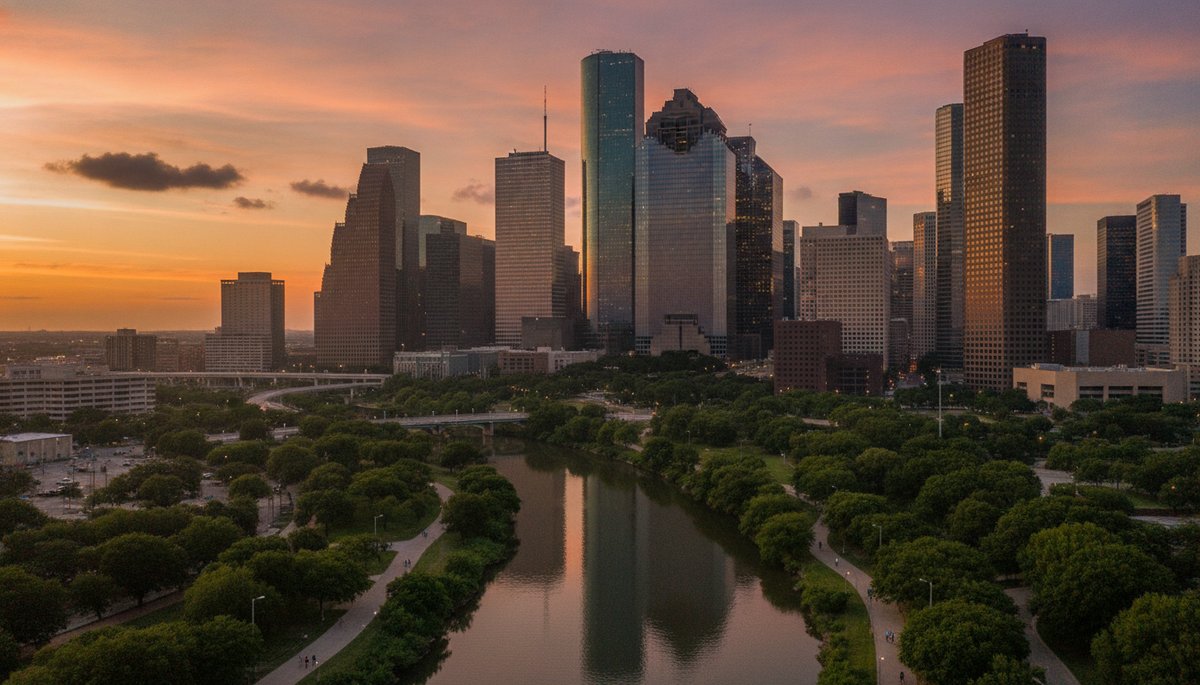
Buffalo Bayou Park — A 160-acre linear park running through the heart of the city. Rent a kayak, cycle the bayou trails, or just watch the downtown skyline reflect off the water at sunset. Completely free, and a great place to escape between matches.
Discovery Green — A 12-acre urban park in downtown, walking distance from the George R. Brown Convention Center. Regularly hosts live music, movies, food events, and — during the World Cup — fan activations. A natural gathering point for visiting fans.
Houston Museum of Natural Science (Museum District) — World-class collections and a permanent hall that's free to enter. The planetarium and butterfly center are paid but well worth it. Air-conditioned, obviously — which in Houston in July is not a minor bonus.
The Houston Galleria — If you need a half-day of pure air-conditioned comfort, Houston's signature indoor mall (400+ stores, restaurants, a full ice rink) does the job. It's also genuinely impressive as a piece of American mall architecture.
Tex-Mex and BBQ — Houston has an exceptional food scene, but you'd be shortchanging yourself not to eat the local specialties. For Tex-Mex: El Real Tex-Mex Cafe (Midtown) is a classic. For BBQ: Truth BBQ (Heights) and Killen's Barbecue (Pearland, worth the drive) regularly rank among the state's best. Get there early — lines are long on weekends.
Houston World Cup 2026: What You Need to Know
The Stadium: Key Facts
NRG Stadium opened in 2002 and has hosted Super Bowls, NCAA events, and international soccer friendlies. For the World Cup it becomes Houston Stadium — all tickets, signage, and broadcasts use that name. The retractable roof and air conditioning system are unique in the tournament and are the primary reason FIFA assigned Houston its full complement of seven matches despite the punishing summer climate.
Key numbers: 68,311 capacity (soccer config), 7 matches (5 group stage, 1 Round of 32, 1 Round of 16), July 4 Round of 16 is the highlight fixture.
FIFA Fan Festival Houston
The official FIFA Fan Festival is held in EaDo (East Downtown) at 2301 Dallas Street, near Shell Energy Stadium. It runs from opening match day on June 11 through the World Cup Final on July 19, open on every match day (closed on official rest days: July 8, 12, 13, 16, 17). Admission is free. Gates open 90 minutes before the first match of the day. The Via Fútbol (Green Corridor) route connects the festival to Discovery Green and downtown hotels by foot, making it easy to combine a fan-festival afternoon with a downtown evening.
Do I Need a Visa for the 2026 World Cup in Houston?
Visitors from the 42 Visa Waiver Program (VWP) countries — including most EU nations, the UK, Japan, South Korea, Australia, and New Zealand — can apply for ESTA authorization online and don't need a full visa. Canadian and Bermudan citizens require neither a visa nor an ESTA. All other nationalities need a US B1/B2 visitor visa.
FIFA PASS gives ticket holders who purchased directly from FIFA access to a priority US visa appointment scheduling system — it speeds up getting an interview slot but doesn't guarantee approval. Apply as early as possible; consular processing times are running long in 2026.
Before You Go: Quick Logistics
Weather: Houston in June–July averages 92–96°F (33–36°C) with humidity that pushes the heat index above 105°F (40°C) on peak afternoons. This is serious heat. Plan outdoor activities for early morning or after sunset, hydrate aggressively, and use air-conditioned spaces (museums, the Galleria, your hotel) during midday. Inside NRG Stadium: a comfortable 72°F (22°C) — bring a light layer for the temperature shock between outside and inside.
Currency: US dollars, accepted everywhere. Contactless payment (Apple Pay, Google Pay, cards) is standard across all venues.
Language: English is primary; Spanish is widely spoken — Houston has one of the largest Latin American communities in the US, which is reflected in its food, culture, and the energy around a soccer tournament.
Tickets: No walk-up sales at the stadium. All tickets managed through FIFA's official channels and Ticketmaster's Last-Minute Sales Phase (first-come, first-served, live through the end of the tournament).
Safety: Houston's tourist areas — Downtown, Midtown, Museum District, EaDo, the Medical Center — are well-patrolled during major events. Be street-smart after dark, keep bags secure in crowded transit areas, and use rideshare apps rather than unmarked taxis.
Heading to multiple host cities? See our World Cup 2026 host cities travel guide for the big picture. Also catching games in Dallas or Atlanta? Both are reasonable day-trip or overnight-extension options from Houston — plan flights early, as connections between host cities sell out around match weekends.
Ready to sort your connectivity before you fly? The Airalo USA & Mexico Unlimited eSIM covers the US and Mexico on one plan — no SIM swaps, no surprise roaming bills. (Affiliate link — I may earn a commission at no extra cost to you.)
Frequently Asked Questions
Which stadium hosts the 2026 World Cup in Houston?
How many matches does Houston host at the 2026 World Cup?
How do you get to NRG Stadium by public transit for the World Cup?
Do I need a visa to attend the 2026 World Cup in Houston?
Where is the FIFA Fan Festival in Houston and is it free?
You Might Also Like
Travel + Remote Work Briefing — October 24, 2026
Travel + Remote Work Briefing — October 22, 2026
Travel + Remote Work Briefing — October 21, 2026