
Remote Startup Jobs: How Many Let You Work Anywhere?
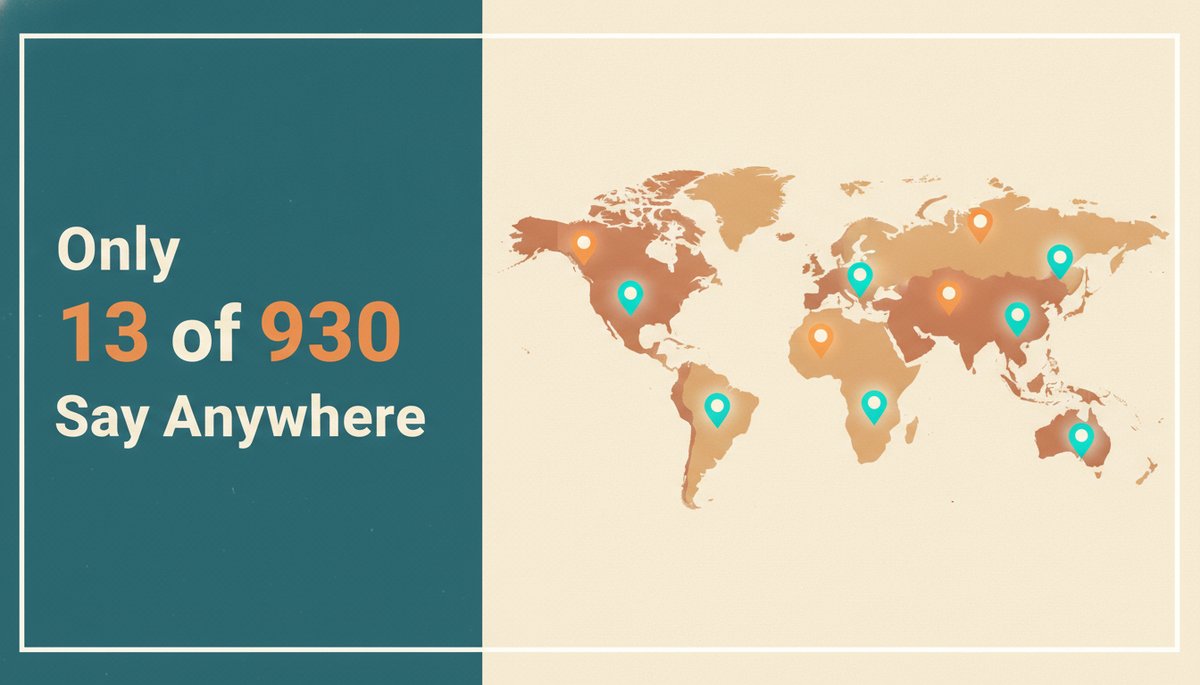
Remote Startup Jobs: How Many Let You Work Anywhere?
Data as of October 22, 2026 · updated monthly
Cite as: job4travelers Remote YC Startup Jobs Report, October 2026: only 13 of 930 remote job postings at Y Combinator startups (200 or fewer employees) explicitly allow work from anywhere. This is our own analysis, not official Y Combinator data.
You find the perfect remote job. Great team, fun product, and the title says "Remote." You scroll to the location line and it says "Remote (US only)." Your Lisbon sublet just got a lot more awkward.
If you've been burned by that, you're not imagining it. We analyzed the public job boards of Y Combinator startups to see how many "remote" roles really let you work from anywhere. The answer is smaller than the word "remote" suggests. Here's the data, plus how to read a listing before you apply.
Quick Answer: How Many Remote Startup Jobs Let You Work Anywhere?
Quick Answer: In our October 2026 analysis of YC startup job postings (Y Combinator companies with 200 or fewer employees), only 13 of 930 remote postings explicitly allowed work from anywhere. 62.8% were listed in or defaulted to the US, and 192 were based outside the US and Canada. "Remote" at a startup usually means "remote within a specific place."
Key findings (our October 2026 analysis of YC startup job postings):
- 930 remote postings at 182 YC startups (postings are counted separately from companies).
- 13 postings (about 1.4%) literally said anywhere, worldwide or global. This is a floor, explained below.
- 62.8% were listed in or defaulted to the US.
- 192 postings were remote roles based outside the US and Canada.
This post is about location, not salary. Pay gets one section, further down. For the broader picture beyond startups, see our analysis of remote jobs that let you travel.
Are Remote Startup Jobs Really Remote?
Mostly in the work-arrangement sense, but with a place attached. In our October 2026 analysis of YC startup job postings, all 930 postings were remote roles, yet only 13 (about 1.4%) said anywhere outright. 62.8% were listed in or defaulted to the US, and 192 sat outside the US and Canada. Remote usually means remote within a place.
How We Did This (Methodology)
Method box. We analyzed 6,458 distinct open job postings on the public job boards (Ashby, Greenhouse and Lever) of 452 YC companies, collected on October 22, 2026; the remote figures here cover the startup ones. "YC startups" means Y Combinator companies with 200 or fewer employees. The company list comes from the yc-oss directory mirror, and the jobs come from each company's public job board. Region is parsed from each posting's location text, or from the job board's country field when the text names no place. This is a one-day snapshot, so we make no trend claims. It is not official Y Combinator data.
Remote made up 27.1% of the startup postings that state a work arrangement. Two denominators matter here: 930 is a count of postings, and 182 is the number of companies that posted them.
Two things to keep in mind. First, the sample covers 452 of the 1,491 YC companies that were hiring, because those are the ones whose job boards we could resolve. Second, a startup can write one thing in a listing and be flexible in practice. We can only measure what the listing says.
Where Are Remote Startup Jobs Actually Based?
Most remote startup jobs are listed in or default to the US. In our October 2026 analysis of YC startup job postings, 584 of 930 remote postings (62.8%) were US, and the next-largest groups were Europe (70) and a bare "Remote" with no country (66).
Of the 584, 446 named a US location in the posting text. The other 138 carried a US location only from the job board's country field, which is often the company's headquarters. So the right wording is "listed in or defaulted to the US," not "tied to the US."
| Region in the listing | Remote postings |
|---|---|
| United States (listed or defaulted) | 584 |
| Europe | 70 |
| "Remote" with no country | 66 |
| "Americas" / "North America" with no country | 64 |
| United Kingdom | 38 |
| Asia-Pacific | 38 |
| India | 25 |
| Latin America | 18 |
| Anywhere / worldwide / global | 13 |
| Canada | 10 |
| Africa / Middle East | 3 |
| Unknown | 1 |
Source: job4travelers analysis of YC startup job postings, October 22, 2026. Region comes from the location text first, then the job board's country field. Rows do not overlap.
Outside the US and Canada, 192 remote postings were spread across Europe, the UK, Asia-Pacific, India, Latin America and Africa/Middle East. That's real, but it's a fraction of the total. If you want a role tied to your region, the data says you'll be choosing from a short list, not a long one.
One more catch for non-US applicants. Of those 192 postings, 145 listed no pay currency at all, so you often can't tell from the listing how an overseas role is paid. That's a question for the first call.
What Remote Jobs Can You Do Anywhere in the World?
Very few, and the number we can count is a floor. In our October 2026 analysis of YC startup job postings, only 13 of 930 remote postings (about 1.4%) explicitly said anywhere, worldwide or global. They are spread across the same role families as other remote jobs, but with so few listings, the listing matters more than the job type.
Why a floor? That 1.4% counts only listings that say it outright, at YC startups only. It is not a figure for all remote jobs, and it can't tell you how many employers would quietly hire from abroad.
Here's the truth in four numbers:
- 13 postings explicitly say anywhere/worldwide/global. These are the safest bets for remote jobs anywhere in the world.
- 66 postings say only "Remote." No country is given. It might mean anywhere. It might mean "anywhere in the US, we just didn't say." You have to ask.
- 64 postings say "Americas" or "North America" without a country.
- 584 postings are listed in or default to the US.
So if you're looking for remote jobs for non US citizens, the 13 are the cleanest starting point, and the 192 postings based outside the US and Canada may be worth checking next. The 66 "Remote" listings are worth a polite email, not an assumption.
What Jobs Do Digital Nomads Land at Startups?
Startups hiring remotely lean toward engineering and sales. In our October 2026 analysis of YC startup job postings, engineering led with 268 remote postings, followed by sales (180), customer roles (86), marketing (58), data and machine learning (56), operations (54), product (47) and design (39).
| Role family | Remote postings |
|---|---|
| Engineering | 268 |
| Sales | 180 |
| Customer support / success | 86 |
| Marketing | 58 |
| Data / machine learning | 56 |
| Operations | 54 |
| Product | 47 |
| Design | 39 |
Source: job4travelers analysis of YC startup job postings, October 22, 2026. Other categories (finance/legal, healthcare, people, other) are not shown.
If you're asking what jobs allow you to work anywhere, this is the honest read: the role matters less than the listing. A support role that says "Remote (US)" doesn't help a nomad in Bali, while an engineering role that says "Worldwide" does. If customer roles are your lane, we've covered remote customer service jobs for travelers in more detail.
The seniority reality check
Startups are a hard route for beginners. In the same analysis, remote postings skewed experienced: 416 mid-level, 216 senior and 133 manager roles, plus 130 at staff or director level (60 staff-plus and 70 director-plus), against just 31 junior and 4 intern postings.
That doesn't mean you can't get in. It means a brand-new graduate with no portfolio will find few doors open at YC startups right now. If you're earlier in your career, you may want to turn your skills into online work while you travel first, then come back to startups with proof of work.
Do Remote Jobs Pay Less?
A little, at YC startups. In our October 2026 analysis of YC startup job postings, remote roles had a median posted salary of $170,000 (n=396), compared with $187,500 for on-site roles (n=1,097) and $200,000 for hybrid (n=378). For travelers, remember that these are ranges companies posted, not what people earn, only USD postings are included, and some employers adjust pay by where you live, so ask directly. Many startups also offer equity: 45.5% of startup postings mentioned it, which is a mention, not a value.
How to Spot Location Limits in a Listing
Look at the location line, residency or work-authorization wording, payroll terms and time-zone overlap. Read the fine print before you fall in love. These are practical red flags (advice from reading lots of listings, not data from the report):
- "Remote (US)" or "Remote, [country]": this is the location line telling you where you must live.
- "Must reside in..." or "authorized to work in...": a residency or work-authorization requirement. Often a deal-breaker for nomads.
- "US payroll," "W-2," or "US-based employee": usually means they can't pay you from abroad.
- Time-zone overlap, such as "overlap with PST hours": you may be allowed to travel, but a Bali evening is not a California morning.
- Mentions of an employer of record (EOR) or contractor setup: a good sign for hiring abroad, but ask who bears tax and benefits.
- A list of "entity countries": the company can hire only where it has a legal presence. If yours isn't named, ask.
- Just "Remote" with nothing else: unclear. Ask before you invest hours in the application.
A short email works: "Can this role be done from [your country]? Do you hire there, and how would I be paid?" Their answer will save you a lot of time.
What Does "Remote (US)" Mean?
It means the work is remote but you need to live in, and be authorized to work in, the US. It's a location limit, not a work-from-anywhere offer. Also note that in our data, 138 of the 584 US postings carried a US location only from the job board's country field, so the listing itself may not spell out the limit.
Can I Work Remotely for a US Company While Living Abroad?
Sometimes, but it depends on the employer's setup and on the rules where you live, not just the job. We can't give you legal or tax answers, and neither can a job listing. What we can give you is the list of questions to ask before accepting an offer.
- Payroll: Would I be an employee, a contractor, or hired through an employer of record? Who pays, and in which currency?
- Tax residency: Where would I owe income tax, and does staying in one country for months change that? (Consider a tax professional.)
- Visas and permission to work: Am I allowed to work remotely from this country on the status I'd have? See whether working remotely on a tourist visa is legal and countries that offer a digital nomad visa.
- Time zones: What hours do I need to be online, and can I realistically meet them?
- Equipment: Who buys and ships my laptop, and what happens if it needs repair abroad?
- Insurance and benefits: Does health coverage work outside the employer's country? See staying connected and insured while working abroad.
Get the answers in writing, and be upfront about where you plan to live. A startup that is relaxed about location will usually be glad you asked early.
How to Find Remote Startup Jobs
The fastest route is to go to the source instead of a generic job aggregator. Use the YC job board and the career pages of the startups you like, then filter for remote and read each location line.
- Start with the YC job board and search for YC companies' remote jobs in your role family.
- Go to the company's own career page. Many YC startups post on Ashby, Greenhouse or Lever (most of the boards we could find were on Ashby), so the listing there is the real one.
- Prioritize listings that say anywhere or worldwide, then your region, then plain "Remote."
- Check the company's team page. Where do the current employees live? A team spread across time zones is a good sign.
- Ask before you apply when the location is unclear.
- Apply with proof of work, especially if you're junior. Startups skew toward people who can show what they've shipped.
Limitations
- Startups only. These findings apply to YC startups with 200 or fewer employees, not to all remote jobs or to big companies.
- Partial coverage. We analyzed 452 of 1,491 YC companies that were hiring, those whose public job board we could identify.
- The anywhere figure is a floor. It counts only listings that say anywhere, worldwide or global outright.
- Listing text is not company policy. A posting may be more flexible than it reads, and region is parsed from free-text location lines and, where those name no place, the job board's country field.
- Posted pay is not actual pay. Salary figures cover only the roughly 48% of remote postings that listed pay, USD only.
- Snapshot, not a trend. This is a single-day view, with no claims about change over time. We update the report monthly.
- Not official. This is our analysis of public job boards, not data from Y Combinator.
The Bottom Line
Remote startup jobs are real, and there are hundreds of them. But the data says "remote" is not the same as "work from anywhere": in our October 2026 analysis of YC startup job postings, just 13 of 930 remote postings said so outright. Read the location line, ask the awkward question early, and treat the explicit-anywhere listings as the gems they are.
Packing for the road? Start with the questions above, and read up on staying connected and insured while working abroad before you book that flight.
Frequently Asked Questions
What remote jobs can you do anywhere in the world?
Can digital nomads work for YC startups?
What does 'Remote (US)' mean?
How to find remote startup jobs?
Do remote jobs pay less?
You Might Also Like

Travel + Remote Work Briefing — November 19, 2026

Travel + Remote Work Briefing — November 18, 2026

Travel + Remote Work Briefing — November 17, 2026