
Travel + Remote Work Briefing — September 9, 2026
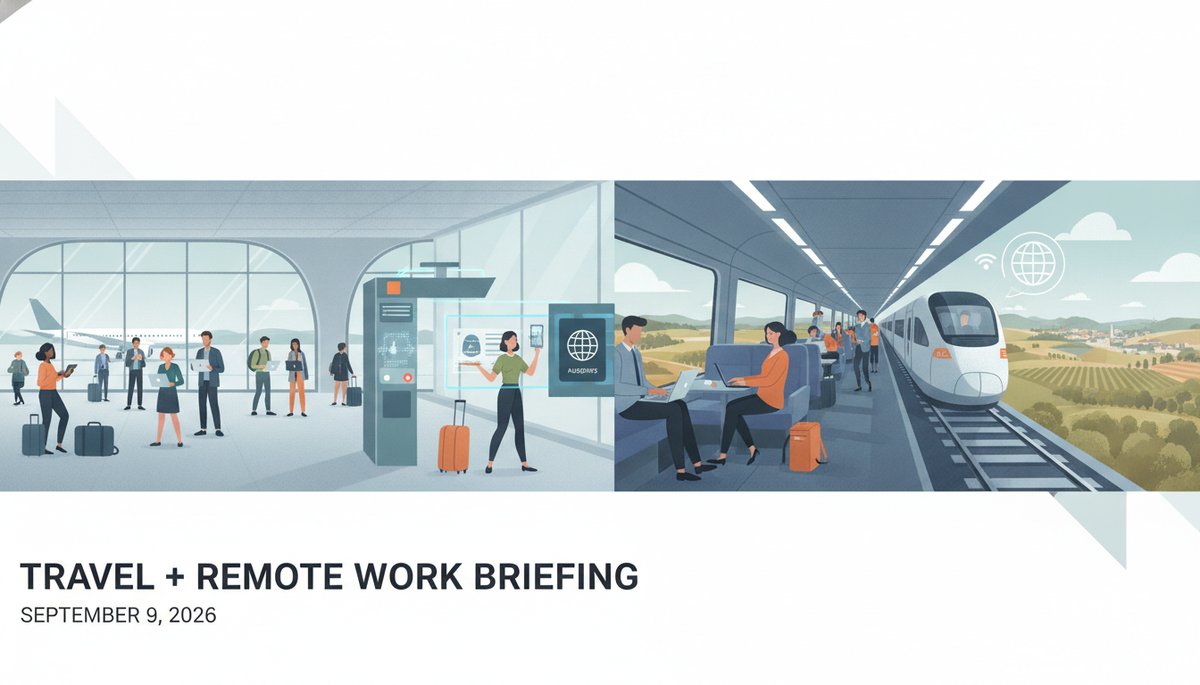
For anyone who works while moving, the productive part of a trip is rarely the destination — it is the hours spent in a station or a seat. Two stories today measure exactly that. A new index ranks Europe's busiest rail hubs on the things that decide whether a travel day is billable or lost: punctuality, wait times, WiFi, services. And a wave of premium economy redesigns splits neatly into cabins built for working and cabins built for sleeping. Neither is a story about luxury. Both are about how much of a travel day you actually get to keep.
Which European train stations can remote workers actually trust for a working commute?
Zürich Hbf topped the Consumer Choice Center's European Railway Station Index 2026, an advocacy group's ranking of the continent's 60 busiest stations, with Paris Gare du Nord second and Amsterdam Centraal third — while Berlin Hbf, Germany's highest-ranked stop, landed only 18th, according to the index as reported by Euronews.
The index scored stations on delay rates, average wait times, in-station services, accessibility, free WiFi availability, railway coverage and ticket-type variety — the same variables that determine whether a travel day between calls is manageable or a write-off. Switzerland posted a 94.1% national punctuality rate, with Luzern Hbf delayed just 0.3% of the time and Zürich Hbf at 4%. Germany fared far worse: 15 of the bottom 30 stations were German, Berlin Hbf saw 61.1% of services delayed with a 20-minute average wait, and the national delay average hit 49.4%, versus a Europe-wide average of 29%, per the index.
For anyone stitching together work and travel, that gap matters. Building an itinerary around Swiss or French hubs like Zürich, Bern or the Paris stations means tighter, more predictable buffers between a train and a scheduled call. Routing through Germany, where the index found roughly half of services running late, means padding in extra time — or risking a missed meeting for a delayed connection.
Source: Euronews Travel
Is premium economy's newest seat tech actually built for working, or just for comfort?
Emirates, American Airlines and a handful of other carriers are rolling out 2026 premium economy upgrades that split into two camps — privacy-and-power features useful for working onboard, and rest-and-food features aimed at pure comfort — according to a roundup from Euronews Travel.
Emirates is fitting Airbus A350 premium economy with what it calls the "world's first electric premium economy seat with full-height privacy screen," paired with wireless charging across a 2-3-2, 28-seat cabin. American Airlines is retrofitting 44 premium economy seats on Boeing 777-300ER long-haul jets with sculpted headrests, adjustable calf and foot rests, and wireless charging, USB-C and AC power — a surface-and-power combination that matters more for a laptop session than a nap. Other carriers are chasing rest instead: Air New Zealand's Skynest sleep pods, launching in December 2026, offer four-hour private sessions from roughly NZ$495 (about €250), and TAP Air Portugal's Economy Prime, which launched in June 2026, guarantees an empty middle seat across four-across long-haul rows. Wizz Air's new Wizz Class, also debuting in 2026, adds first-row space and an empty middle seat but skips power or privacy upgrades. Anyone weighing the spend should match the seat to the trip — see our remote work travel gear guide for what actually earns its keep in the cabin.
Source: Privacy screens and sculpted headrests: What's new in premium economy? — Euronews Travel
What to watch
- Whether German operators respond to the index's delay figures before winter timetables lock in. Half of services running late is the difference between rail being a viable working commute and a gamble.
- Whether more carriers follow American's power-and-surface approach rather than Emirates' privacy-screen route. The two solve different problems, and only one of them helps you type.
- Whether empty-middle-seat products like TAP's and Wizz Air's hold their guarantee as load factors rise into winter — the guarantee, not the legroom, is what makes them workable.
You Might Also Like
Travel + Remote Work Briefing — October 9, 2026

Travel + Remote Work Briefing — October 8, 2026
Travel + Remote-Work Briefing — October 7, 2026